Field & Son (Birmingham, England)
Robert Field, Senior, was born in about 1787, in Birmingham, England, and was recorded as being an optician on all of his children’s christening records. Philip Carpenter (1776-1833) opened an optical and scientific instrument shop in about 1808 in Birmingham and his heirs sold it to Robert Field, Senior, in 1837. The business became Robert Field and Son in 1845. The 1851 census found the whole family at the New Street location. Robert Field, Sr., died in 1851 and the business was thereafter operated by Robert Field, Junior, as “R. Field and Son”. Robert Field, Jr. probably sold the business in the early 1870s and died in 1883, at the age of only 54 years old. R. Field & Son is primarily known for the prize they won from the Society of Arts in 1855. The Society of Arts, in London, requested applications for two different microscope types and Field was awarded the top prize for each. One prize was for a compound student microscope to be provided for 3 Guineas or less. The other award was for a mechanically and optically simple school microscope, to be provided for 10 shillings, 6 pence, or less. R. Field and Son also sold a compound version of the school microscope, which presumably sold for a higher price. The pattern of Field’s student prize-winning compound microscope became immensely popular and was widely copied by other manufacturers, being known as the Society of Arts pattern. In addition, the Field businesses produced more complex, expensive microscopes, and a wide variety of other scientific and mathematical instruments.
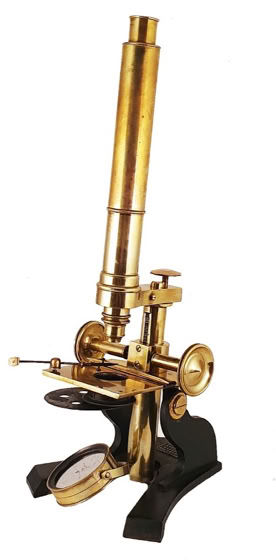
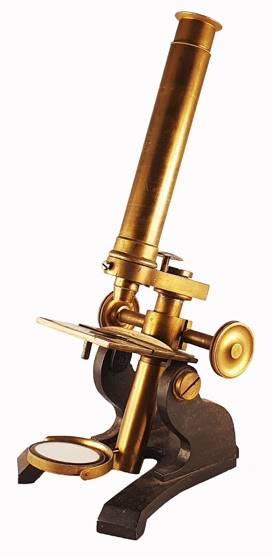
Microscope 29 (R Field & Son; student microscope; c. 1860)
Microscope 485 (R Field & Son; Society of Arts microscope; c. 1860)
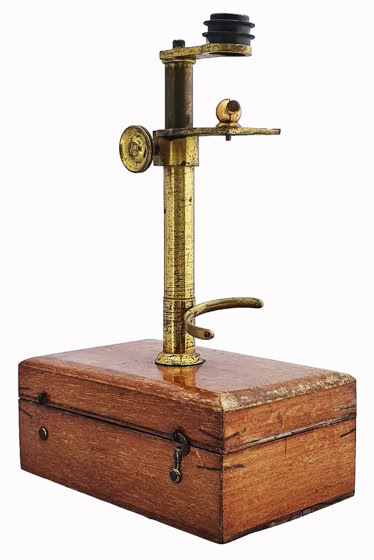
Microscope 97 (R Field & Son; school microscope; c. 1860)
Microscope 277 (R Field & Son; school microscope; c. 1860)
Microscope 382 (assigned to Robert Field; Teasdale's Field Naturalist's Microscope; c. 1880)