
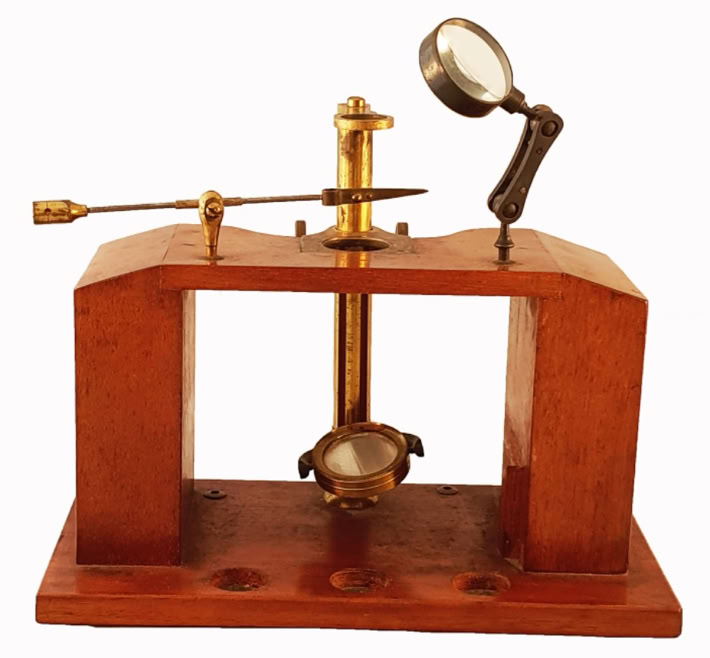
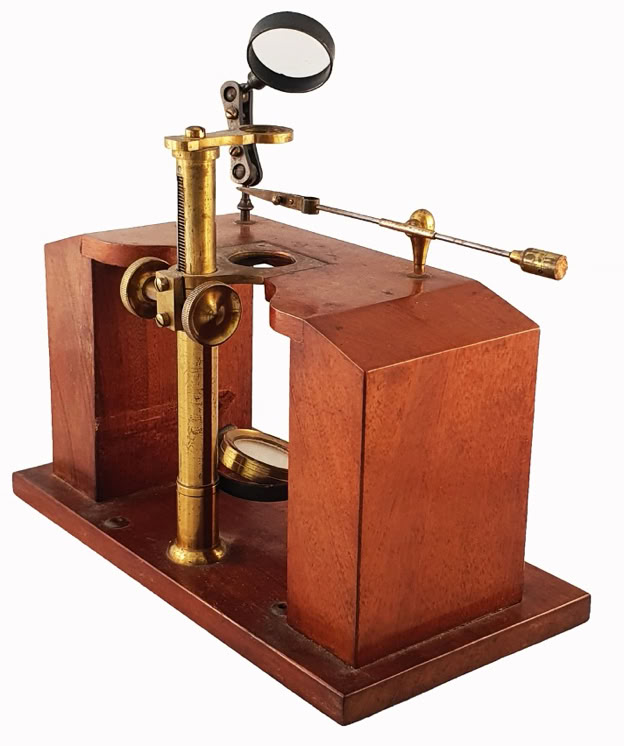
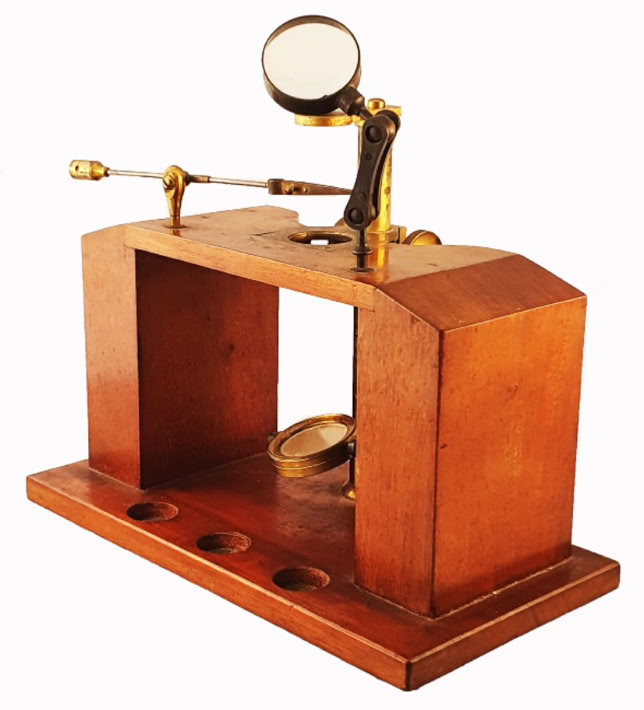
Microscope 382
(assigned to Robert Field; Teasdale's Field Naturalist's Microscope; c. 1880)
Robert Field Senior was born around 1787 in Birmingham, England, and is recorded as having worked as an optician in the christening records of his children. Philip Carpenter (1776–1833) established an optical and scientific instrument business in Birmingham around 1808. Following Carpenter's death, his heirs sold the business to Robert Field Senior in 1837. The firm became known as Robert Field & Son in 1845 and traded from 113 New Street, Birmingham, between 1845 and 1851, before moving to Suffolk Street, where it remained until well after 1863. The 1851 census records the entire Field family living at the New Street premises. Robert Field Senior died in 1851, after which the business was continued by his son, Robert Field Junior, trading as R. Field & Son. Robert Junior probably sold the business in the early 1870s and died in 1883, aged only 54. R. Field & Son is particularly renowned for the awards it received from the Society of Arts in 1855. The Society invited manufacturers to submit designs for two types of microscope, and Field was awarded the first prize in both categories. The first was for a compound student microscope costing no more than three guineas, while the second was for a mechanically and optically simple school microscope, priced at no more than 10 shillings and sixpence. The firm also marketed a compound version of the school microscope, presumably at a higher price. In addition to these relatively inexpensive instruments, the Field business manufactured more sophisticated and expensive microscopes, as well as a wide range of other scientific and mathematical instruments.
Microscope 381 is a simple, wooden-framed dissecting microscope. Although unsigned, the instrument is attributed to Robert Field & Son and should be dated to approximately 1880. A similar instrument was described in the 1882 volume of the Journal of the Royal Microscopical Society (JRMS; Figure 1) and subsequently documented by Brian Bracegirdle in his 2005 catalogue of the microscopy collections at the Science Museum, London, published by Little Imp Publications. The JRMS described the instrument as follows: “Teasdale's Field Naturalist's Microscope … is made by Messrs. Field of Birmingham, and was designed by Mr. W. Teasdale with the view of providing the working microscopist with a really cheap and efficient dissecting microscope, and it may be readily certified that it fully accomplishes these objects. It is so simply and substantially made that it may be used by an intelligent child, as well as by the experienced microscopist. It was termed a Field Naturalist rather than a Dissecting Microscope to disarm the suspicion with which some people look upon an instrument with the latter name as a rack or means of torture for frogs.”
Washington Teasdale (1830–1903) was educated in civil engineering and subsequently worked in India, where he was involved in the development of the subcontinent's railway system. After returning to England, he inherited his grandfather's estate and devoted much of his time to scientific pursuits. He was a Fellow of both the Royal Microscopical Society and the Royal Astronomical Society, as well as a member of several local scientific and other organisations. Around 1876, Teasdale designed his simple, wooden-framed microscope, an example of which is represented by Microscope 382 (Figure 2). These instruments were subsequently manufactured and marketed by Robert Field & Son.
Note: This instrument was kindly donated by Dave Levell (Pembrokeshire, Wales) in May 2023.

Figure 1. Teasdale's Field Naturalist's Microscope as engraved in the 1882 volume of the Journal of the Royal Microscopical Society.
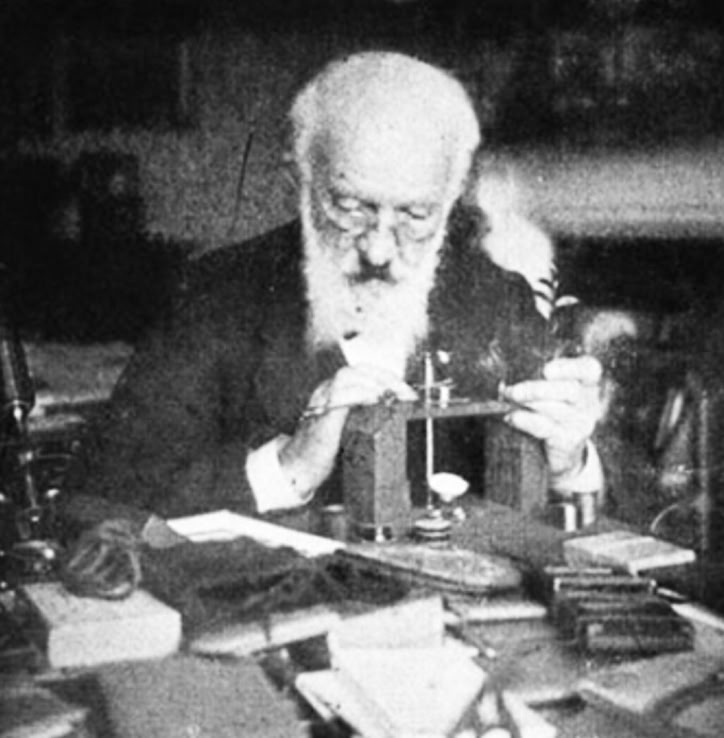
Figure 2. Washington Teasdale with his Field naturalist’s microscope (adapted from www.themicroscopist.net).