


Microscope 84
(J Parkes & Son; worker microscope; c. 1900)
Based in Birmingham, England, J. Parkes & Son manufactured microscopes, scientific instruments, and related equipment and supplies from the mid-nineteenth century into the twentieth century. Recognising the growing demand among students and middle-class amateur microscopists, the firm specialised in affordable instruments, making microscopy accessible to a wider market. James Parkes established his business in 1815, initially manufacturing small metal goods, including jewellery cases and other metal fittings. His only son, Samuel, joined him as a partner around 1846, forming J. Parkes & Son. By the 1850s, the firm was producing a range of microscopes, and its 1857 catalogue prominently featured both microscopes and prepared slides. Numerous examples of later Parkes microscope models are also known to have been manufactured for sale through other retailers. Following James Parkes’s death in 1877, Samuel continued to operate the business under the established name. When Samuel died in 1896, his only son, Samuel T. H. Parkes, and his nephew, James Moulton, took over the firm. Moulton left the partnership in 1908, after which Samuel T. H. Parkes continued the business independently for several more years, with evidence of its operation extending at least into the late 1920s.
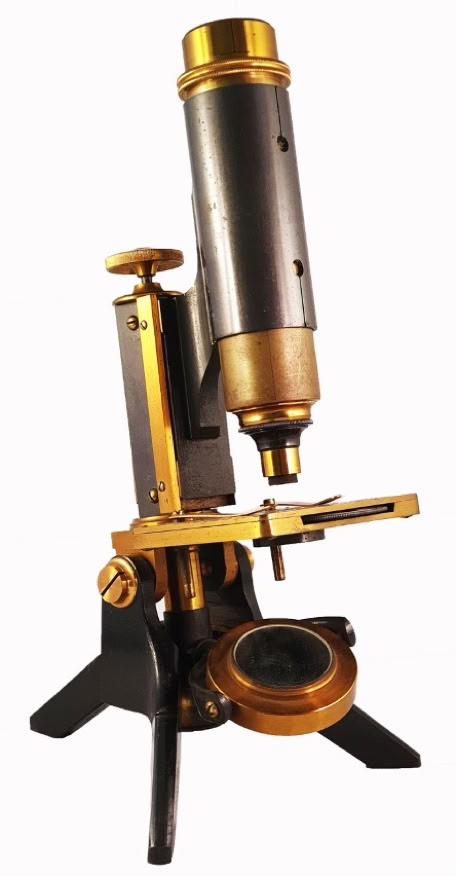
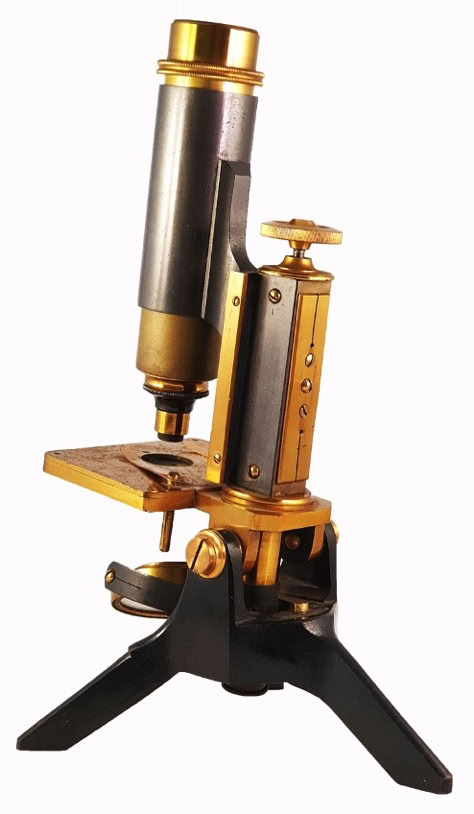
Microscope 84 is a Parkes “Worker” microscope, a model first introduced during the 1890s that remained in production well into the twentieth century (Figure 1). Designed as a practical, economical instrument, the Worker could be equipped with a rotating wheel of apertures or configured to use a microscope objective as a condenser. Its finish consists predominantly of oxidised brass, complemented by details in polished, lacquered brass. The mirror has both plane and concave surfaces, allowing illumination to be adapted to different working conditions. Parkes microscopes commonly bear either the J. Parkes & Son signature or the firm's distinctive eye trademark. However, many instruments were supplied with an unsigned brass nameplate, allowing retailers to add their own branding. This instrument bears the characteristic eye trademark, identifying it as a Parkes instrument.
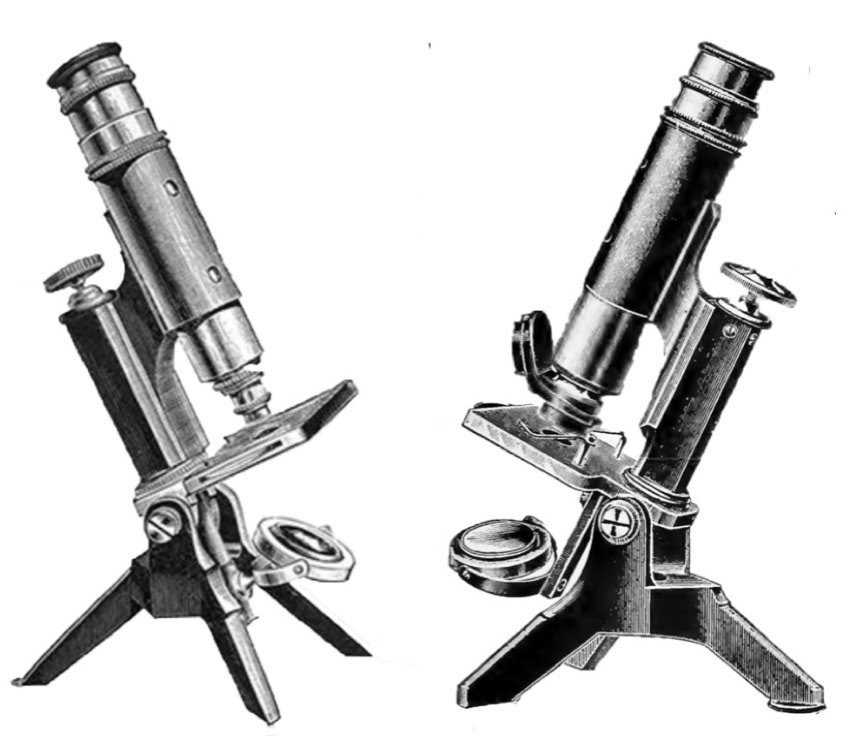
Figure 1. Illustration of the Parkes’s Worker microscope model as shown in an advertisement in the 1898 ‘Illustrated Annual of Microscopy’ (left) and in a 1914 advertisement from a Newcastle optical shop (right).