
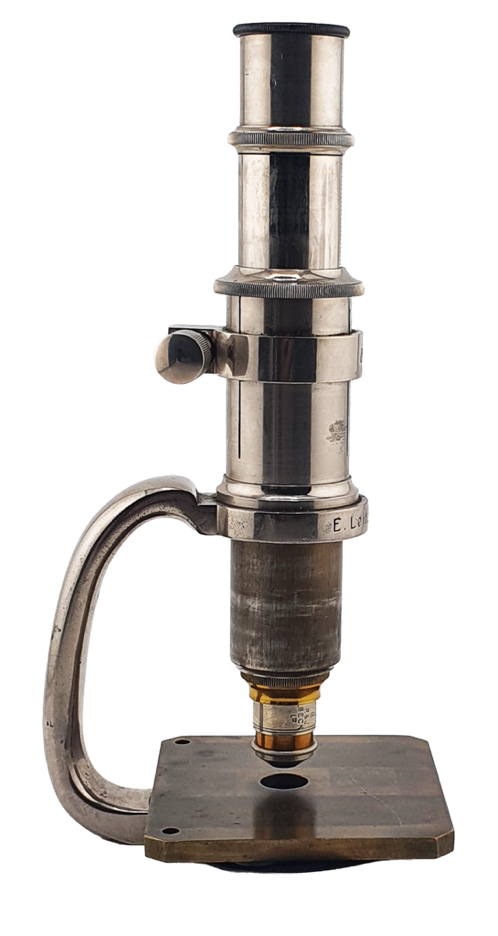
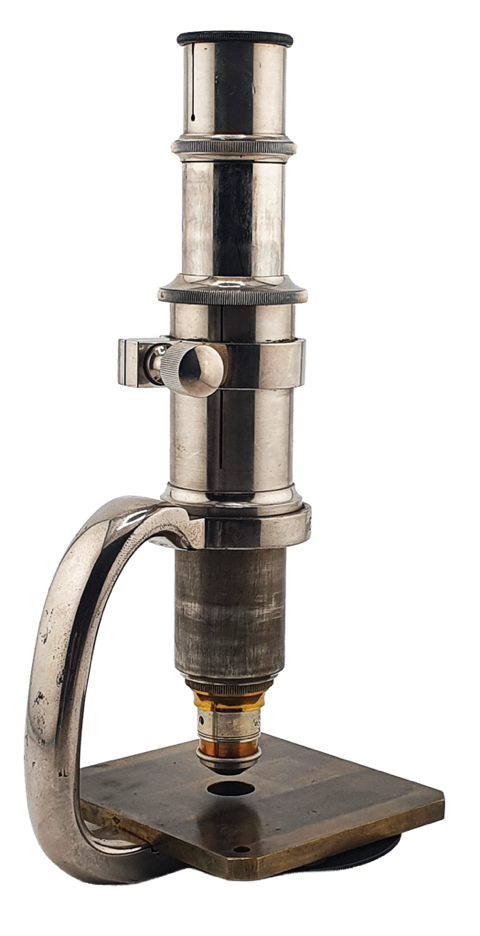
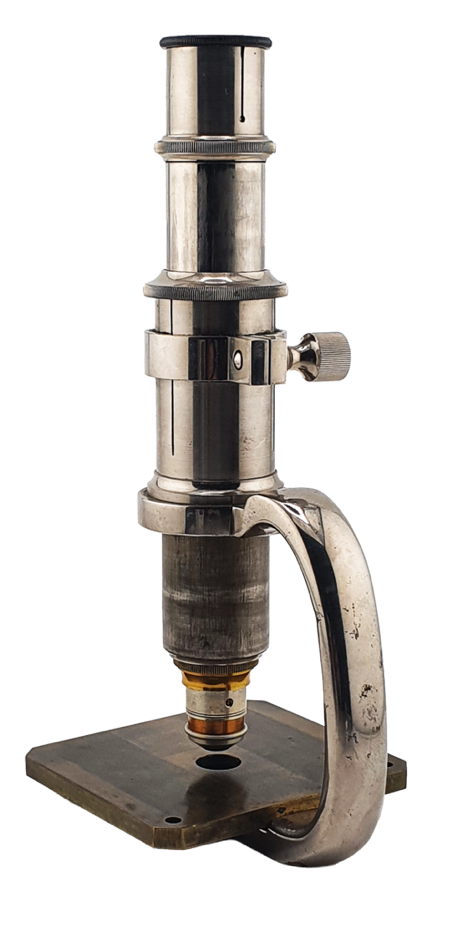
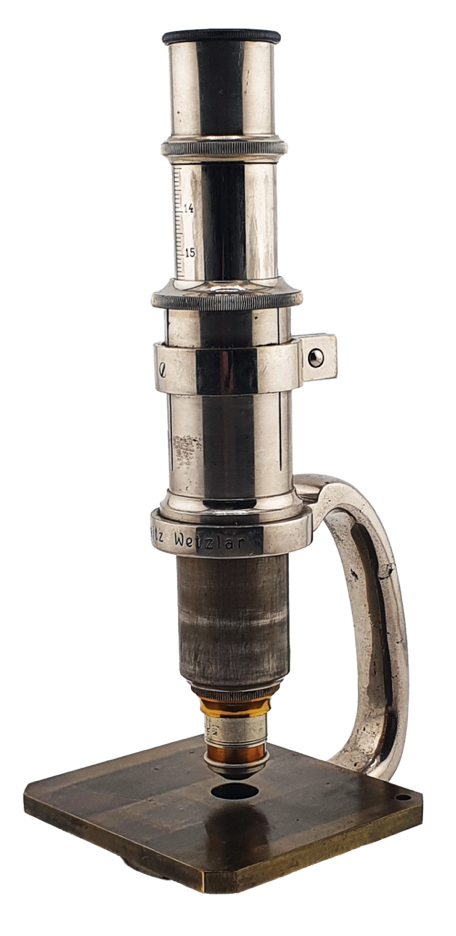
Microscope 670
(Ernst Leitz; demonstration microscope; 1930s)
In 1849, Karl Kellner founded the Optical Institute in Wetzlar, Germany. Within a few years, microscopes had become the company's principal product. In 1865, the company employed an engineer named Ernst Leitz, who soon became a partner. Leitz took over the business in 1869 and renamed it the Optical Institute of Ernst Leitz. Following his death in 1920, his son, Ernst Leitz II, became the sole owner of the company. During the 1970s, competition from Japanese manufacturers, particularly Olympus and Nikon, increased considerably. These companies were producing modern microscope designs of excellent quality at relatively competitive prices, placing considerable pressure on established European and American manufacturers. Several long-established microscope companies consequently closed, merged or were taken over. In 1974, Wild Heerbrugg acquired a majority interest in Ernst Leitz Wetzlar, although the company continued to develop new ranges of compound microscopes under the Leitz name. The last member of the Leitz family retired from the company's board of directors in 1986. At the beginning of 1987, Ernst Leitz Wetzlar GmbH and Wild Heerbrugg AG merged to form the Wild Leitz Group. In 1988, the group was reorganised into smaller companies, with Leica Camera becoming a separate entity. In 1990, the merger of Wild Leitz Holding AG with the Cambridge Instrument Company led to the formation of the Leica Holding B.V. group. The Leica name subsequently became the principal brand for the group's microscopes and other scientific optical instruments.
Microscope 670 is a demonstration microscope engraved "E. LEITZ WETZLAR" and should be dated to the 1930s. Instruments of this type were commonly used in practical teaching sessions in university science departments and medical schools. They allowed several students to examine the same specimen in turn, with the microscope being passed from one student to another. The instrument is fitted with a rotating wheel of apertures but has no mirror for illumination. Instead, it must be oriented towards an external light source to illuminate the specimen. A similar Leitz demonstration microscope, with a condenser instead of wheel of apertures, was already featured in the company's catalogues by 1905 and continued to appear in editions published up to at least 1926 (Figure 1).
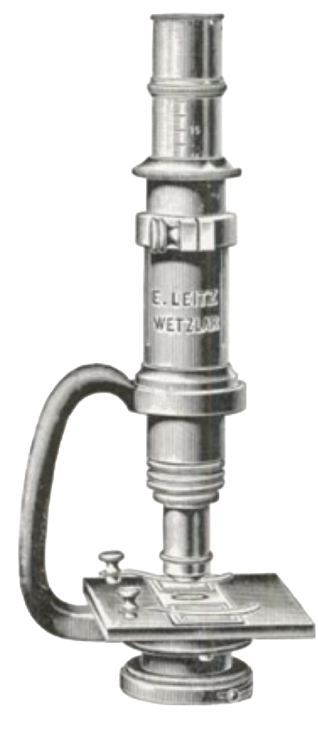
Figure 1. Ernst Leitz’s demonstration microscope with condenser, as featured in a 1926 catalogue of the firm.