


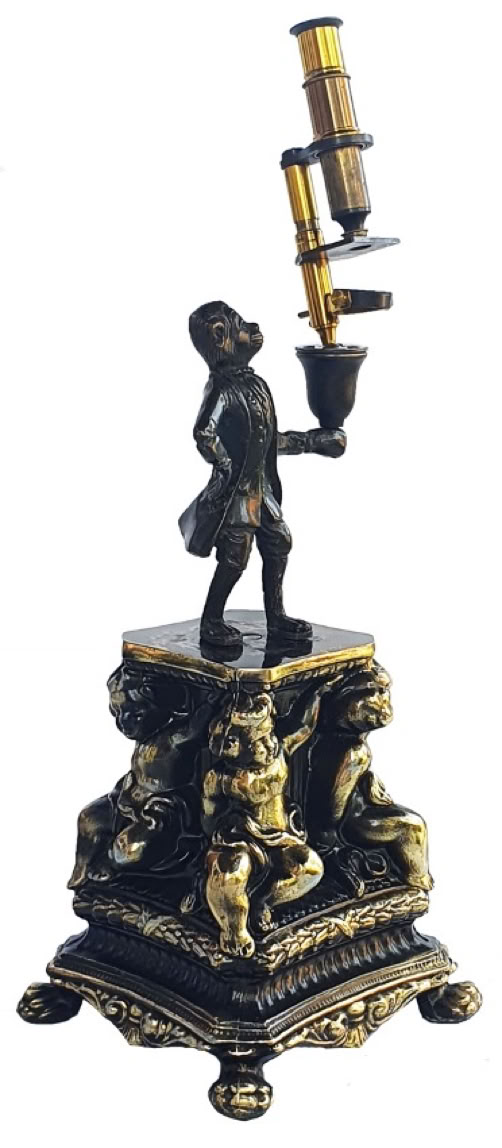
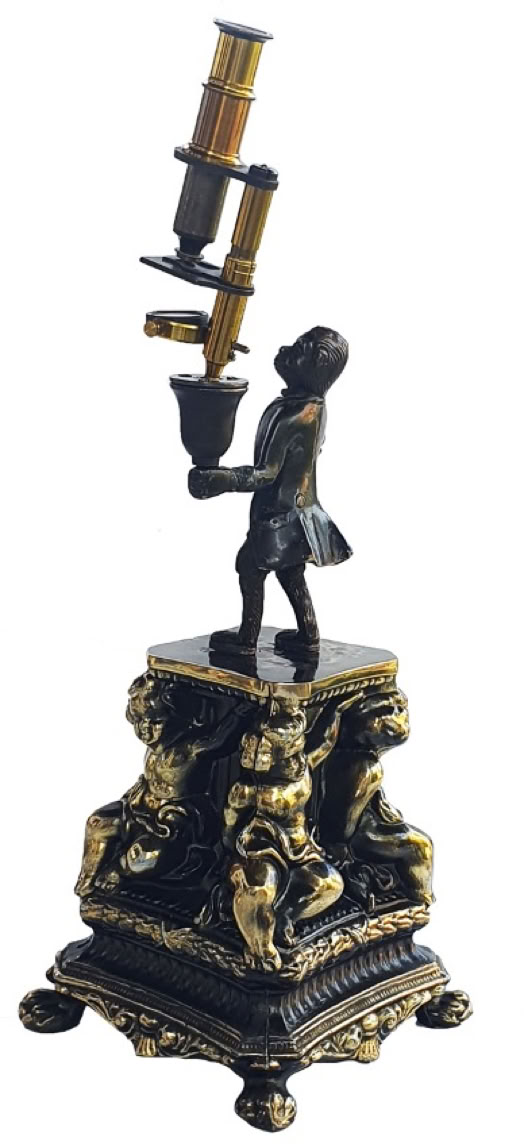
Microscope 630
Reproduction inspired by Moreau’s Monkey Microscope
Microscope 630 is an unusual modern reproduction, approximately 45 cm in height, loosely inspired by the monkey microscopes introduced by M. Moreau of Paris in the late nineteenth century.
Monkey microscopes and their maker
Monkey microscopes appear to have been introduced during the second half of the nineteenth century by a Parisian scientific instrument maker identified in contemporary literature simply as M. Moreau. In this context, “M.” almost certainly stands for Monsieur, rather than representing the maker's initials. The earliest, and apparently only known, contemporary reference to these instruments was published in the February 1889 issue of the Journal of the Royal Microscopical Society, reporting the exhibition of a monkey microscope at the Society's December 1888 meeting. The account described it as follows: “This microscope …, by M. Moreau of Paris was exhibited at the December meeting of the Society. In its design art as well as science has been drawn on, for instead of an ordinary base and pillar a figure of a monkey is introduced which holds in its hands the stage and mirror, while the cross-arm carrying the body-tube and socket is screwed to the top of its head”. The description was accompanied by an illustration of the instrument (Figure 1).
No other contemporary documentation has so far been identified, including advertisements or manufacturers' catalogues. Only a small number of examples are known today, in public and private collections, including the Science Museum in London and a private collection in France. They appear occasionally at auction, where they have attracted considerable prices. These are exceptionally small instruments, approximately 10 cm in height, constructed from bronze, steel and brass, the latter variously lacquered, blackened or silver-plated.

Figure 1. Moreau’s monkey microscope as featured in the 1889 volume of the Journal of the Royal Microscopical Society.
The identity of M. Moreau remains uncertain. Moreau was a relatively common surname in France, and no documentary evidence has yet been found that conclusively identifies the maker of the 19th century monkey microscopes. One possible candidate is Robert Moreau, a Parisian instrument maker associated with an address at 16 rue de Seine. However, no evidence directly connects him with the monkey microscopes. Another possibility is a Moreau associated with the optical business that subsequently became linked to Maison Deraisme, at 167 rue Saint-Maur, Paris. A trade catalogue published in 1901–1902 identifies Moreau as one of the founders of the business formed through the combination of the firms of Teigne, Moreau and Balland in 1849. Although this establishes a connection between a Parisian instrument-making business and a maker named Moreau, it does not provide sufficient evidence to identify him as the maker of the monkey microscopes.
A possible caricature of Charles Darwin?
Monkey microscopes have sometimes been interpreted as satirical or figurative references to Charles Darwin and the controversy surrounding evolutionary theory. Following the publication of On the Origin of Species by Means of Natural Selection in 1859, Darwin developed his ideas on human evolution in The Descent of Man, and Selection in Relation to Sex (1871). His suggestion that humans and other primates share a common ancestor made him a frequent subject of caricature, including the well-known image reproduced in Figure 2.
The finely modelled monkey head of Moreau’s microscope illustrated in Figure 1 has been considered particularly suggestive in this respect. Its somewhat human-like features have even been interpreted as bearing a resemblance to Darwin's distinctive face. The instrument could therefore be understood as a humorous reference to the contemporary debate over human origins. Nevertheless, no contemporary evidence has been found to confirm that the monkey microscopes were intended as caricatures of Darwin. It remains an appealing, but unproven, interpretation.

Figure 2. Charles Darwin’s cartoon published in The Hornet magazine on 22 March 1871, at the time as a reference to his recently published book Descent of man. This is likely the most famous caricature depicting Darwin as an ape or monkey - see “Caricatures of Charles Darwin” by John van Wyhe.
Later monkey microscope-like constructions

A different monkey microscope-like instrument was once offered for sale on a North American website. According to the website's description, it was probably intended as a “spoof on Darwinism” and bore an engraving on the microscope identifying its maker as “A. Van Emden, Amsterdam” (Figure 3). Despite this inscription, the instrument appears to be a much more recent assemblage by an unidentified maker or artist. It seems to incorporate several components of different dates: an antique microscope attributed to Abraham van Emden, a Dutch scientific instrument maker active until around 1860; a brass monkey originally made as a candleholder, a type of ornament relatively common from the mid-twentieth century; and a brass lamp base, apparently also manufactured during the mid-twentieth century by a North American company identified as M.C. Co. (Figures 4 and 5). The combination is certainly unusual, and the resulting instrument is an impressive piece of art.

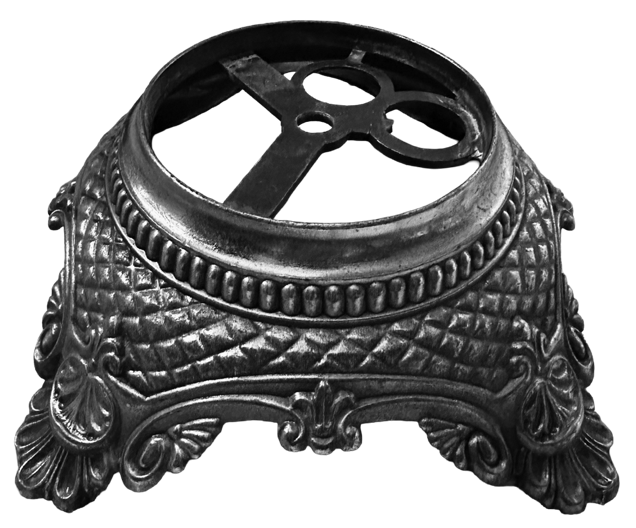
Figure 3. Monkey microscope as featured in a long-discontinued North American website (accessed 27 June 2025).
Figure 4. Brass monkey candlestick as sold in an eBay auction (September 2026).
Figure 5. Brass lamp base made by M.C. Co. as sold in an eBay auction (August 2026).
Another, more recent, reproduction of a monkey microscope appeared on the auction website Artcurial. According to the auction description, it was made by Rafael San Marcial, a Spanish restorer of antique scientific instruments, and had previously belonged to the Camacho-Pallas collection (Figure 6). This attractive instrument was constructed using an original brass soap holder in the form of a monkey, a type of object that was relatively common during the mid-twentieth century (Figure 7). It provides another example of how the distinctive form of Moreau's original design has inspired later interpretations and reproductions.


Figure 6. Monkey microscope reproduction as featured on the website Artcurial (accessed 27 June 2025), made by Rafael San Marcial in Spain.
Figure 7. Brass monkey soap holder as sold in an eBay auction (November 2025).