


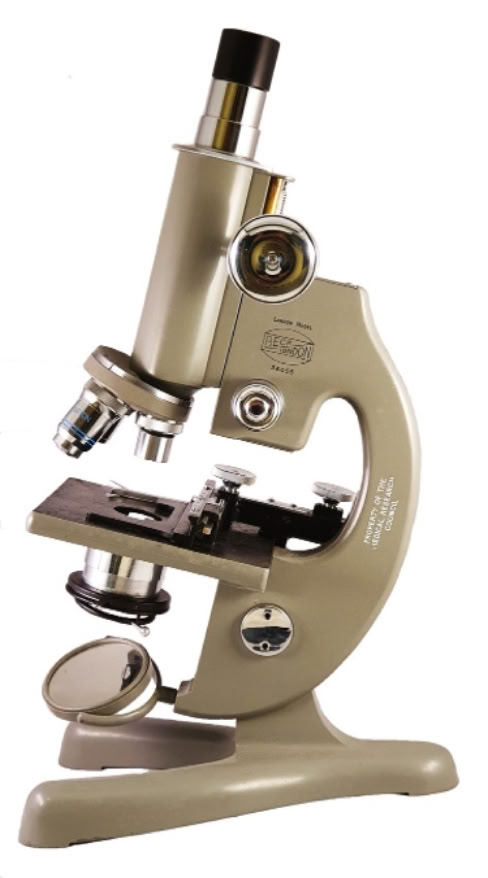
Microscope 63
(R & J Beck; microscope model 47A; 1950s)
R & J Beck occupies an important place in the history of British microscope manufacturing. The firm's origins date to 1847, when Richard Beck (1827–1866), nephew of the British optician and physicist Joseph Jackson Lister, entered into partnership with James Smith (1800–1873) in London. Richard's younger brother, Joseph Beck, subsequently joined the business. Joseph Jackson Lister was renowned for his work on achromatic lenses and his contributions to the development of the optical microscope. In commissioning the manufacture of an improved microscope based on his optical designs, Lister worked with James Smith, who was then employed by the instrument-making firm of William Tulley, to produce the microscope stand. Smith subsequently established his own optical instrument workshop in 1837. Through Lister's connections, his nephew Richard Beck became Smith's apprentice in 1843. In 1847, Smith and Richard Beck formed a partnership under the name Smith & Beck. The firm's name changed to Smith, Beck & Beck in 1854, following the admission of Richard's brother Joseph as a partner in 1851. James Smith retired in 1865, and the business became R & J Beck, a name it retained for many decades. Following Richard Beck's death in 1866, aged just 39, Joseph continued to run the business. In 1895, the company became R & J Beck Ltd. By 1968, it had become a subsidiary of the American Ealing Corporation. A corporate descendant of the original firm, Beck Optronic Solutions Ltd, continued the Beck name into the twenty-first century.
Microscope 63 is a Beck Model 47A, bearing serial number 36055 and dating probably to the mid-to-late 1950s (Figure 1). Its light-grey finish is characteristic of the more modern scientific instrument designs that became increasingly common during this period. The model was produced during the late 1940s and 1950s.

Figure 1. Beck’s microscope model No. 47A as featured in a 1962 catalogue of the firm.