


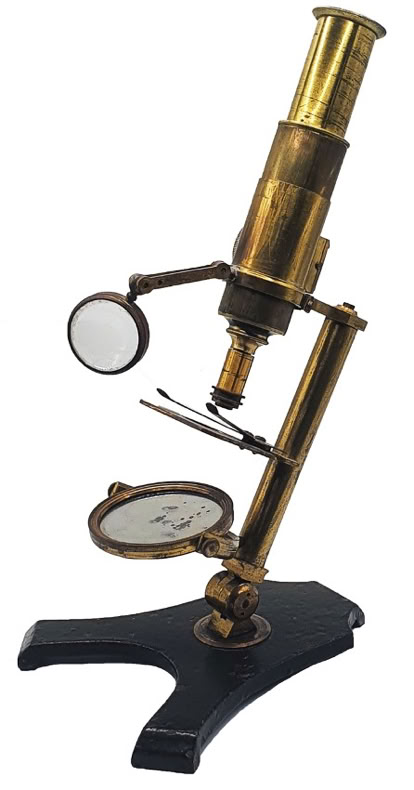
Microscope 607
(assigned to J. Parkes & Son; compound microscope; c. 1860)
Based in Birmingham, England, Parkes manufactured good-quality microscopes and other scientific instruments and supplies from the mid-19th century well into the 20th century. Recognising the growing market among students and middle-class amateur microscopists, the firm concentrated on producing affordable instruments. James Parkes established his business in 1815, initially manufacturing small items such as jewellery cases and other metal fittings. His only son, Samuel, joined him as a partner around 1846, and the business subsequently traded as J. Parkes and Son. By the 1850s, the firm had expanded its production to include a variety of microscopes. Its 1857 catalogue featured an extensive selection of microscopes and prepared slides. Many later microscope models manufactured by J. Parkes and Son are also known to have been retailed by other suppliers. Following his father's death in 1877, Samuel continued to operate the business under the established name. Samuel had one son, also named Samuel, who, together with his cousin James Moulton, took over the business after the elder Samuel's death in 1896. Moulton left the partnership in 1908, after which Samuel T. H. Parkes continued to run the firm independently for several more years. The business remained active at least until the late 1920s.
Microscope 607 is unsigned but is identical to a compound microscope illustrated and described in the firm's 1857 catalogue (Figure 1). It is a relatively simple instrument, which can be dated to around 1860. The catalogue described it as a microscope: “… with joint to incline the body to any angle; rack movement, concave mirror, condenser, 1½ inch object glass, and achromatic combination forming two powers, tweezers, glass slides, and half a dozen best objects, in portable mahogany lock-up case”. Interestingly, this model was no longer included in the firm's 1862 catalogue.

Figure 1. Compound microscope, with joint to incline the body to any angle, as engraved in a J Parkes & Son’s 1857 catalogue. The same microscope and description appeared in the catalogues of other firms at the time, such as in the 1857 catalogue of Spencer, Browning & Co. (London).