


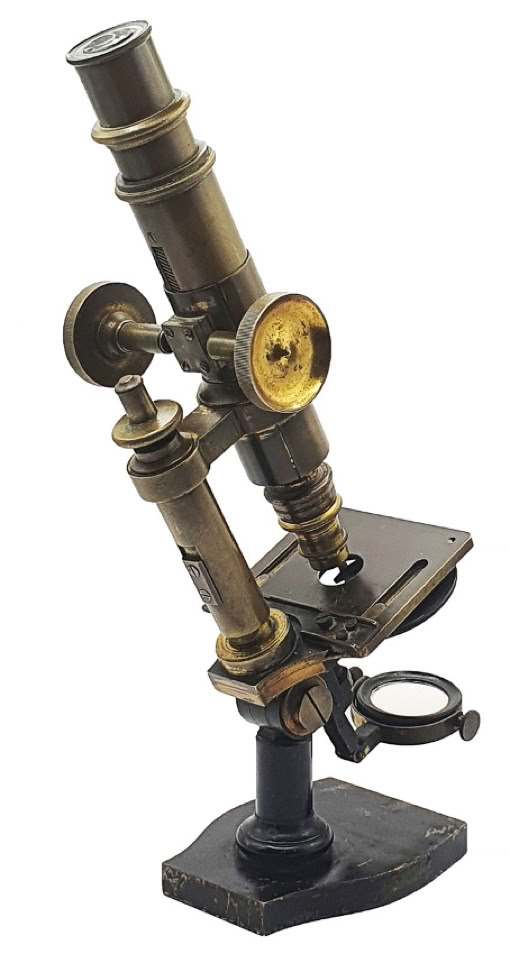

Microscope 601
(Nachet; Petit modèle; c. 1870)
Camille Sébastien Nachet (1799–1881) began his career working with Charles Chevalier before establishing his own business in 1839. At the time, Chevalier, Oberhaeuser and Nachet were the principal microscope manufacturers in Paris. In the late 1850s, Nachet was joined by his son, Jean Alfred Nachet (1831–1908), known as Alfred. The firm became Nachet et Fils around 1862, when Alfred was admitted as a partner. Following Camille's death, Alfred continued the business under the name A. Nachet, which was used from approximately 1880 to 1890. The name subsequently reverted to Nachet et Fils when Alfred's own son joined the partnership. By 1898, Nachet had acquired the businesses of Hartnack & Prazmowski and Bezu, Hausser et Cie. The firm operated from several Parisian premises over the years: Rue Serpente (1839–1862), Rue Séverin (from 1862 until after the Second World War), and, during the 1970s, 106 Rue Chaptal, Levallois-Perret.
Microscope 601 is engraved Nachet et Fils, 17 rue St. Severin, Paris and should be dated to approximately 1870. It is an example of the Nachet petit modèle, a microscope design that appeared repeatedly in the firm's catalogues over several decades, undergoing a number of gradual modifications (Figure 1). The petit modèle is characterised by its distinctive solid foot, supporting a short pillar and a robust inclination joint. A bullseye condenser was attached to the optical tube by means of a dovetail fitting. Over the years, several features of the original design were modified. The sliding pair of substage apertures was progressively replaced by a rotating aperture disc, while the substage mirror became articulated. The articulating arm of the bullseye condenser was also shortened, and the original stage arrangement was replaced by simple stage clips. Finally, the distinctive solid foot gave way to a more conventional horseshoe-shaped base. These successive changes illustrate the gradual evolution of the petit modèle throughout its production history.
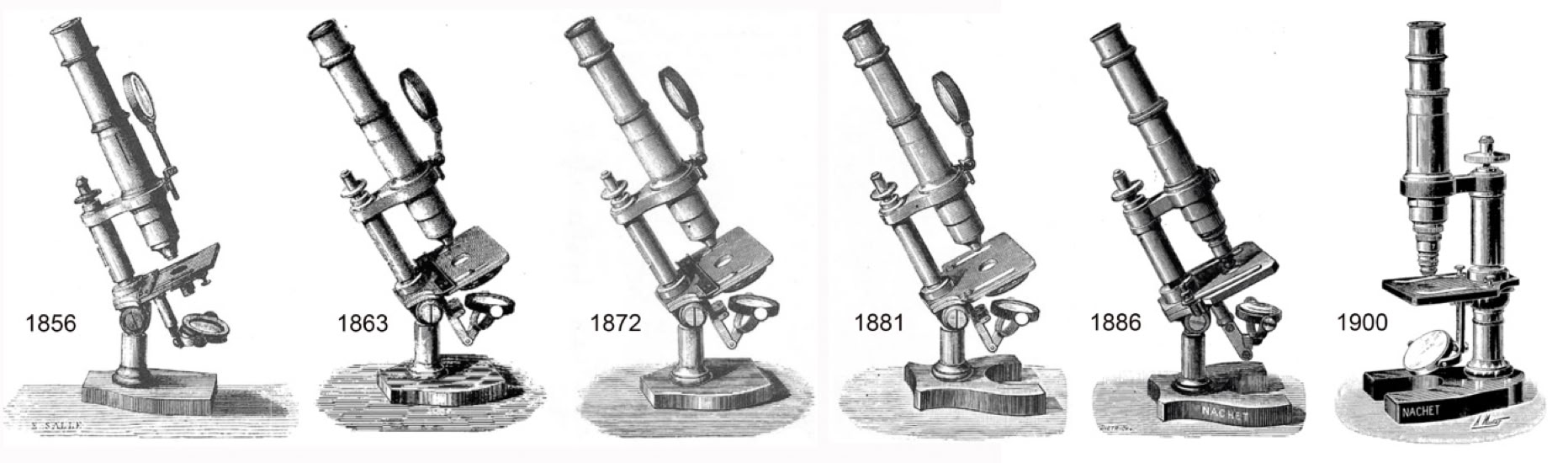
Figure 1. Nachet’s petit modèle microscope as pictured in the firm’s catalogues over the years.