


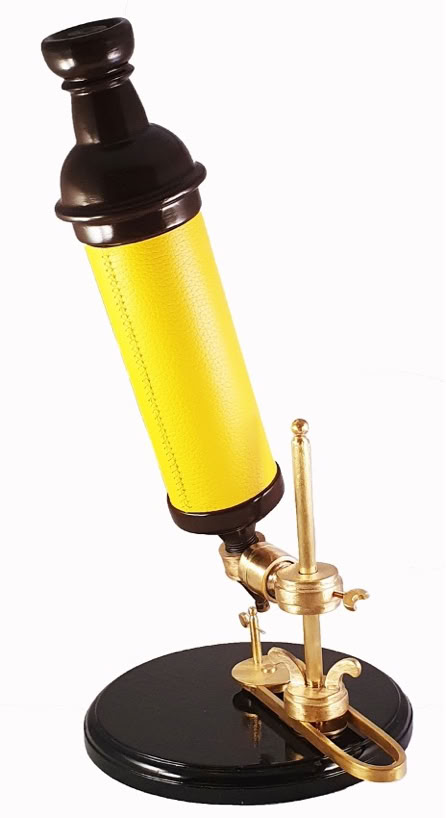
Microscope 577
Robert Hooke’s microscope replica
Robert Hooke (1635–1703) was an English scientist whose contributions spanned numerous fields, including optics and microscopy. His book Micrographia, published in 1665, was arguably his most significant contribution to the history of biology. It contained detailed descriptions and beautifully illustrated observations of a wide variety of specimens examined under the microscope. Among other instruments, Hooke designed a compound microscope and an associated illumination system (Figure 1), which he used to conduct demonstrations at meetings of the Royal Society. Using these instruments, he examined numerous insects and other biological specimens, although perhaps his most famous microscopical observations were those of cork (Figure 1). By examining the structure of cork tissue, Hooke identified and coined the term cells, referring to the small compartments formed by the cell walls of the dead plant tissue. In 1678, Hooke was asked by the Royal Society to verify Antoni van Leeuwenhoek's observations of little animals (bacteria and protozoa). He successfully reproduced these observations, helping to establish the credibility and wider acceptance of Van Leeuwenhoek's discoveries. Hooke also acknowledged that Van Leeuwenhoek's simple microscopes were more powerful and produced clearer images than his own compound microscope. Nevertheless, he considered simple microscopes difficult to use, describing them as "offensive to my eye" and complaining that such instruments "much strained and weakened the sight".
Microscope 577 is a reproduction of Robert Hooke's microscope, together with its associated oil lamp. The instruments were reconstructed from the descriptions and illustrations engraved in Hooke's 1665 book, Micrographia (Figure 1). The replicas are constructed from wood, brass, leather and glass.


Figure 1. Hooke’s compound microscope and oil lamp (left) and microscopical observations of cork (right) as engraved in his book Micrographia published in 1665.