
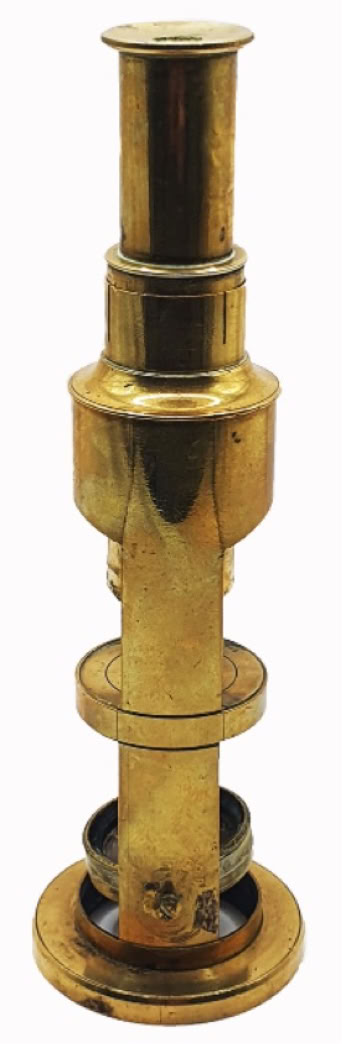
Microscope 567
(Franks; drum microscope, early 20th century)
A. Franks Ltd was an optical and scientific instrument business that traded in Manchester between 1879 and 1950. The business originated with Louis Aubrey Franks, who established a firm in the latter part of the 19th century, trading as L.A. Franks. The company was listed as a manufacturer of photographic apparatus, optician and scientific instrument maker. Following a bankruptcy in 1879, a new business was established shortly afterwards under the name A. Franks, operating as an optician.
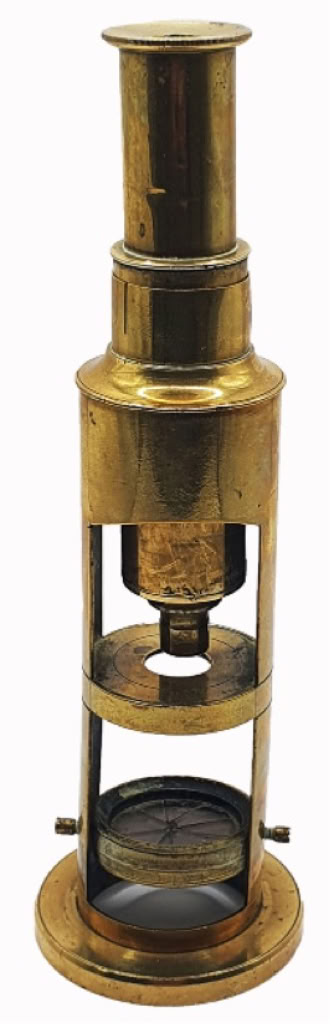
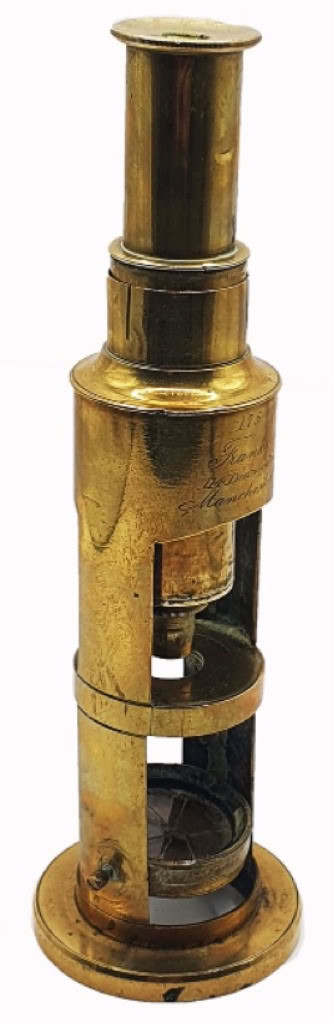
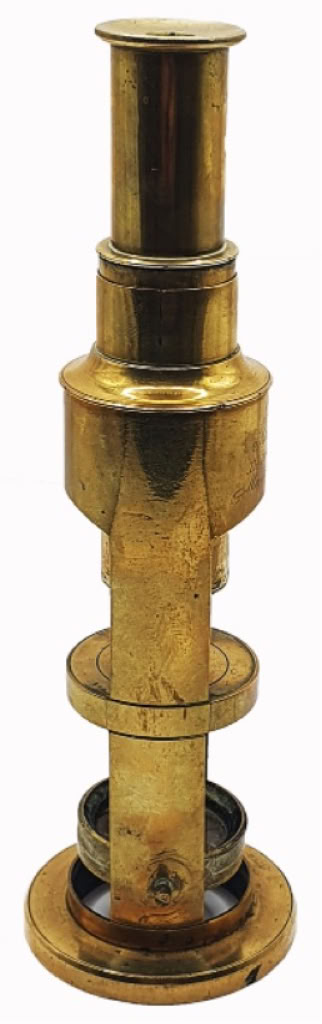
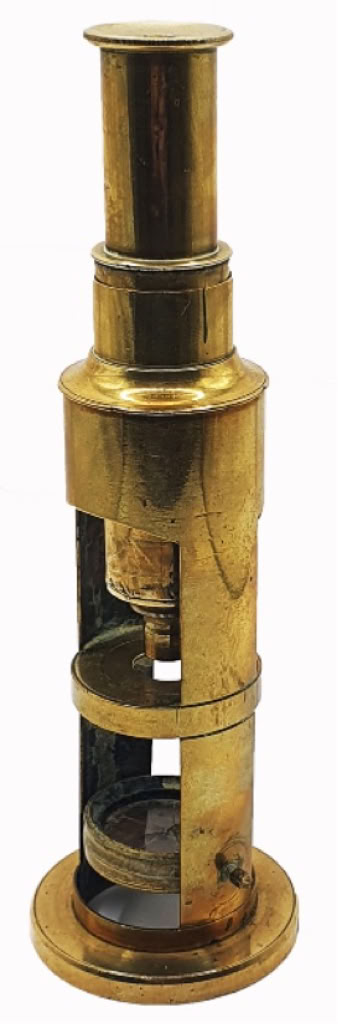
Microscope 567 is a simple drum microscope, probably dating from the early 20th century. The instrument is engraved with the inscription “Franks, 114 Deansgate, Manchester” and bears the serial number 175.
Drum microscopes were apparently first developed by German makers in the early 18th century. However, it was Benjamin Martin who, around 1738, introduced a design that subsequently became particularly popular. His name became closely associated with this type of instrument, which is still frequently referred to as a 'Martin-type' or 'Martin drum' microscope. Simplified versions of the Martin-type microscope were manufactured and sold in considerable numbers during the second half of the 19th century and the early 20th century, particularly by French makers. The most common examples, often of relatively low quality, especially those marketed during the 20th century, are similar to the models illustrated in Figure 1. Variants incorporating a bullseye condenser were also widely available (Figure 2). Nevertheless, several alternative designs were produced by different makers and retailers (Figures 3 and 4). The original drum microscope designs generally incorporated a sliding coarse-focusing mechanism, although some examples were equipped with rack-and-pinion focusing. Basic models had relatively restricted access to the stage, limiting the movement and manipulation of microscope slides. Other designs addressed this limitation through less obstructive arrangements, such as providing access to the stage from two sides (Figure 3), or supporting the body tube with a slender pillar rather than an upward extension of the outer cylindrical housing (Figure 4). Most drum microscopes were supplied with a single objective, although French objectives were often divisible into separate components. Additional objectives and other accessories were sometimes available. Certain models also incorporated an inclination mechanism, allowing the microscope to be tilted for more comfortable observation (Figure 3B).
Earlier drum microscopes were typically supplied in heavy hardwood cases, whereas later examples, particularly those dating from the 20th century, were often housed in thinner, lower-quality pine boxes. Although many of these simplified instruments could be regarded as 'toy' microscopes, more substantial and better-equipped drum microscopes, suitable for more serious observational work, were also available. These included instruments manufactured by firms such as Nachet, Oberhauser and Hartnack, as well as several English makers. Such instruments were relatively common throughout much of the 19th century, although their availability appears to have declined as the century progressed. Figure 5 illustrates an example of a Large Improved Compound Microscope. These instruments are relatively common and generally date from the early to mid-19th century. Some examples bear the name of a retailer, while others are unsigned. Instruments carrying a retailer's name were most likely manufactured for the trade, and the firm identified by the inscription was not necessarily responsible for their actual production. Different versions of these microscopes were manufactured, both with and without rack-and-pinion focusing mechanisms, like microscope 562.

Figure 1. Several versions of drum microscopes sold during the second half of the 19th century as engraved in antique catalogues of different makers and retailers: (A) Spencer Browning & Co (1857); (B) Negretti & Zambra (1859, 1870s and 1885); (C) William McAllister (1867); (D, E) James Queen (1870 and 1872); (F) Miller Bros (1879); (G) R & J Beck (1882); James Queen & Co (1890).

Figure 2. Several versions of drum microscopes as in Figure 1 but including an bullseye lens, sold during the second half of the 19th century as engraved in antique catalogues of different makers and retailers: (A) Spencer Browning & Co (1857); (B) Negretti & Zambra (1859); (C) F & J Amadio (1864); (D) William McAllister (1867); (E) James Queen (1870); (F) James Queen (1870 and 1872); (G, H) Negretti & Zambra (1870s, 1885); (I) Miller Bros (1879).
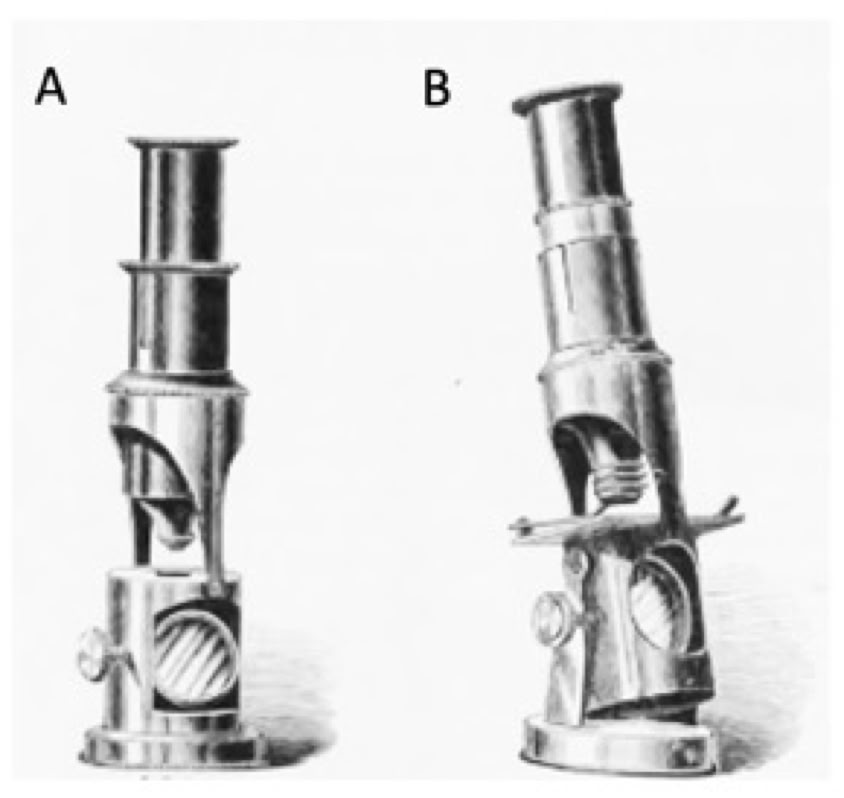

Figure 3. Different versions of drum microscopes as engraved in an antique catalogue of B Kahn & Son (c. 1890).
Figure 4. Different version of a drum microscope as engraved in an antique catalogue of E. Vion (1929).

Figure 5. An engraving of the English Large Improved Compound Microscope as shown in the 1848 Pike's Illustrated Descriptive Catalogue of Optical, Mathematical and Philosophical Instruments.