

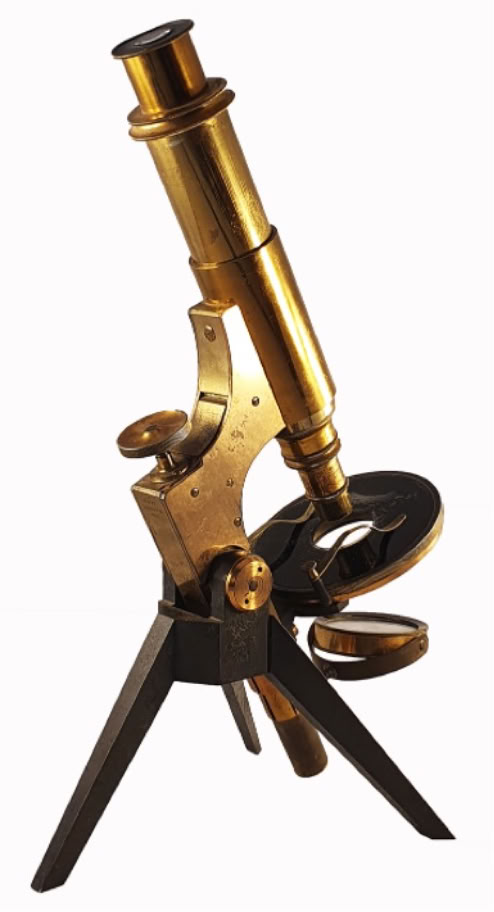


Microscope 528
(Ross; Ross-Zentmayer student’s microscope; c. 1880)
Andrew Ross established his business in 1830. Like James Smith, he collaborated with J. J. Lister, whose work on the mathematical design of microscope objectives led to the development of lenses that were both achromatic and aplanatic. Ross's early microscopes initially followed a construction similar to that of the Jones Most Improved models, before adopting a design resembling Lister's limb. He continued to use this general form until the 1840s, when he developed his own version of the Bar-Limb microscope. This was a particularly stable construction, and Ross also adopted the characteristic Y-shaped foot, with two upright supports, for his larger instruments. The early Ross Bar-Limb microscopes had a triangular-section limb, which was subsequently replaced by a square-section bar and, in the largest and heaviest models, a rectangular-section bar. Ross's Bar-Limb design became highly influential and was adopted by many British microscope makers during the second half of the 19th century. Some manufacturers, including Powell and Lealand, continued to produce Bar-Limb microscopes into the 20th century, long after alternative designs had become established among continental makers. Andrew Ross died in 1859, and his son Thomas continued the business. Following Thomas's death around 1870, Francis Wenham took over the firm. Wenham was an important figure in microscope design, best known for his development of the binocular microscope tube. Under his direction, the firm incorporated features such as swinging substages and long-lever fine-focus mechanisms, both of which had been developed by the American microscope maker Joseph Zentmayer. Ross subsequently produced the well-known Ross-Zentmayer microscopes, which featured prominently in the firm's 1885 catalogue. They were offered in at least four sizes, with most models available in both monocular and binocular configurations. Microscope 509 is another example of this series. The Ross firm continued to manufacture optical instruments well into the 20th century, although the production of large, high-quality microscopes gradually became less central to its activities. The business traded as Ross & Co. between 1837 and 1841 and became Ross Limited in 1897. The firm discontinued microscope production in 1906.
Microscope 528 is signed ‘Ross, London’ and bears serial number 5221. It can be dated to c. 1880 and is an example of the Ross-Zentmayer Student's Microscope (Figure 1). Jabez Hogg described this model in his 1883 book The Microscope: Its History, Construction and Application: “The Ross-Zentmayer Student’s Stand … is a useful instrument on a small scale, possessing all the advantages of a larger microscope. It has an excellent fine adjustment, the milled-head for working which is in as convenient a place as that of more expensive stands. It is not so costly as more pretentious instruments, a consideration often of importance to the student of the collateral sciences. Messrs. Ross make a very good and cheap series of object-glasses for histological work, especially adapted for use with this instrument”. The microscope was available in two versions. The more expensive model had rack-and-pinion coarse focusing (Figure 1), while the less expensive version, represented by microscope 528, used a sliding mechanism for coarse focusing.

Figure 1. Ross (Zentmayer) Student’s microscope as featured in the 1883, 1886 and 1890 editions of Jabez Hogg’s book “The microscope, its history, construction and application”.