
Microscope 509
(Ross; Student’s microscope; 1880s)
Andrew Ross established his business in 1830 and, like James Smith, collaborated with J. J. Lister, the renowned optician who developed a mathematical method for producing objectives that were both achromatic and aplanatic. Ross's early microscopes initially followed a construction similar to that of the Jones Improved models, before adopting a design resembling the so-called Lister Limb. He continued to use this type of construction until the 1840s, when he developed his own version of the Bar-Limb microscope, a particularly stable design. From this period onwards, his larger instruments were also supported on the classic Y-shaped foot with two upright pillars. Early examples of Ross's Bar-Limb microscopes featured a triangular-section limb, which was subsequently replaced by a square-section bar and, in the largest and heaviest models, by a rectangular-section bar. The Ross Bar-Limb design became an influential model among British microscope manufacturers and was widely adopted during the second half of the nineteenth century. Some more conservative firms, such as Powell & Lealand, continued to manufacture Bar-Limb microscopes into the twentieth century, long after the newer Continental designs had become established. Andrew Ross died in 1859, and his son Thomas continued the business. Following Thomas Ross's death around 1870, Francis Wenham took over the company. Wenham was himself an important contributor to microscope design, best known for inventing the binocular tube that bears his name. At some stage, he also introduced swinging substages and long-lever fine adjustment into Ross microscopes, incorporating innovations previously developed by the American microscope manufacturer Joseph Zentmayer. This led to the production of the celebrated Ross-Zentmayer microscopes, which featured prominently in the company's 1885 catalogue. These instruments were available in at least four sizes, with most models offered in both monocular and binocular configurations. Microscope 509 is an example of this distinctive series. The Ross company continued to manufacture optical instruments well into the twentieth century, although the production of large, high-quality microscopes gradually became less significant. The business operated under the name Ross & Co. between 1837 and 1841, and became Ross Limited in 1897. Microscope production was discontinued in 1906.
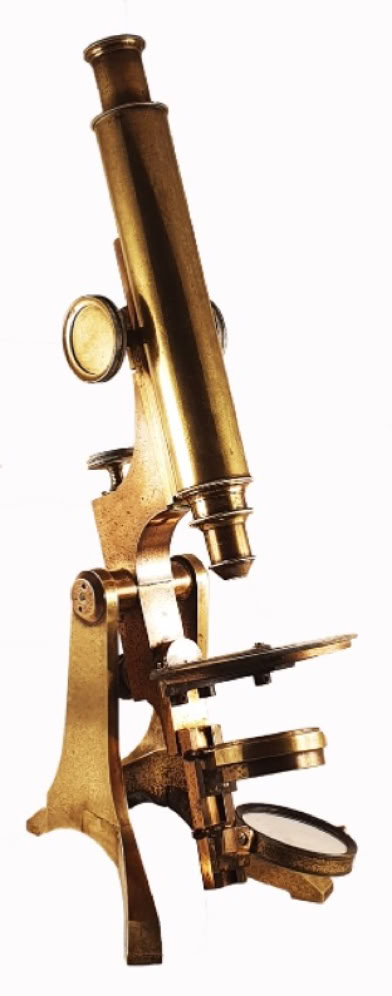
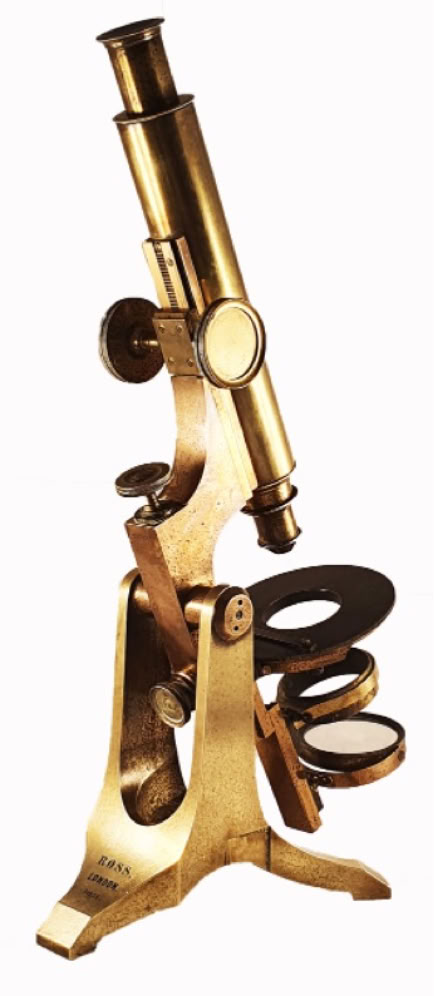
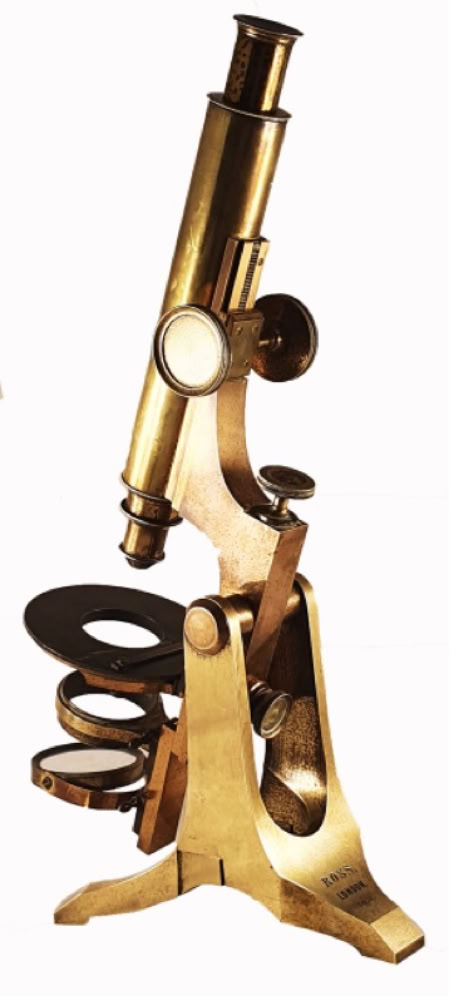
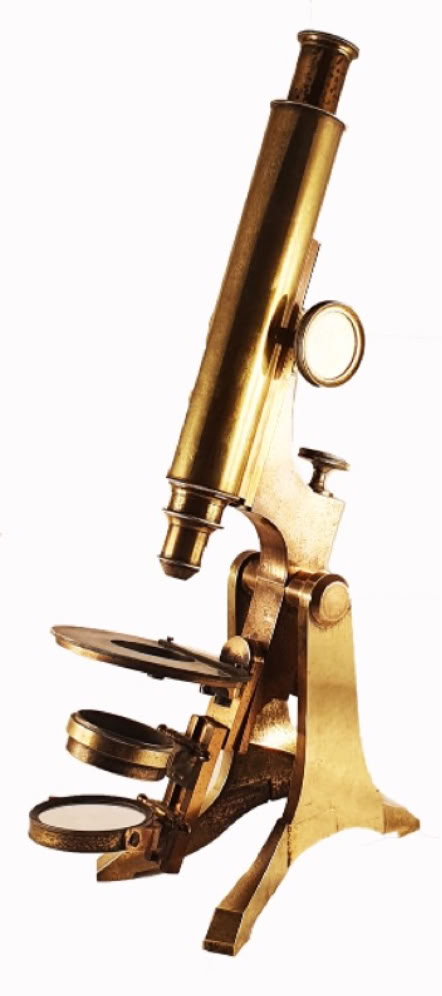
Microscope 509 is signed 'Ross, London' and bears the serial number 5031, suggesting a date in the 1880s. It is an example of the Ross-Zentmayer Student's microscope (Figure 1). Its design and intended capabilities are described in the 1883 edition of William B. Carpenter's The Microscope and Its Revelations, which includes the following passage:
“Another instrument of superior make … with the view of affording to the student the advantage of the swinging tail-piece for oblique illumination devised by Mr. Zentmayer; … This tail-piece swings round a pivot which serves for the attachment of the stage to the limb; and at the back of the limb is a milled-head working on the projecting end of this pivot, by tightening which the stage may be firmly fixed in its ordinary horizontal position, whilst by loosening it the stage may be made to incline to one side or the other. The tail-piece carries, between the mirror and the stage, a sub-stage, fitting into which may be screwed an ordinary 1 inch, 1 1/2 inch, or 2 inch objective, which answers the purpose of an achromatic condenser; and when a pencil of light reflected from the mirror has been made by it to focus in the object, the swinging of the tail-piece to one side or the other will give any degree of obliquity to the illuminating pencil that may be desired, without throwing its focus off the object, as this lies in the plane of the centre round which it turns. The tail-piece may even be carried round above the stage, so that light of various degrees of obliquity may be concentrated upon opaque objects. … A mechanical stage may be added, if desired. The workmanship of this simple model is of the highest class; and there is little real work, of which, in the hands of an observer who knows how to turn the instrument to the best account, it may not be made capable, by the addition of a Polariscope, Paraboloid, and other accessories, which its sub-stage adapts it to receive”.
This description highlights the principal advantage of the Ross-Zentmayer design: its swinging tailpiece allowed the angle of illumination to be adjusted over a wide range while maintaining the focus of the illuminating beam on the specimen. This made the instrument particularly versatile for oblique illumination and the examination of opaque objects. The substage was also designed to accommodate a range of objectives and other optical accessories, including a polariser and paraboloid, further extending its capabilities. Carpenter's favourable assessment of the instrument emphasises the high standard of workmanship and the considerable versatility offered by this student-oriented model.

Figure 1. Ross (Zentmayer) Student’s microscope as featured in WB Carpenter’s 1883 book entitled “The Microscope and Its Revelations”.