


Microscope 506
(WR Prior; inverted microscope; 1960s)
W. R. Prior & Co. Ltd was founded by Walter Robert Prior in 1919. The company initially operated from premises in Eagle Street, Holborn, London, before subsequently moving to Devonshire Street, London. Relatively little is known about the firm's early activities, and no surviving records or catalogues have been identified that establish precisely when or why it began manufacturing microscopes under the Prior name. A 1950 catalogue of microscopes and accessories published by W. R. Prior lists the company's office at Devonshire Street and its factory at Bishop's Stortford, Hertfordshire, England. Manufacturing operations at Bishop's Stortford took place between 1942 and 1957. On 10 January 1947, Walter Robert Prior died at the age of 55. In 1956, the company relocated to a new factory in London Road, Bishop's Stortford, where it continued to manufacture and develop microscopes. Around 1960, W. R. Prior & Co. and Charles Perry merged, although the two businesses retained their separate trading names until approximately 1970. In 1978, W. R. Prior & Co. Ltd was acquired by the Gwyndann Group of Companies, and the company's name was changed in 1979 to Prior Scientific Instruments Ltd. In 1981, Prior Scientific Instruments merged with James Swift & Son Ltd, a microscope manufacturer established in the mid-19th century. A fire at the Bishop's Stortford factory in 1988 forced the company to relocate to its present premises in Fulbourn, Cambridge, England. Prior Scientific subsequently expanded its activities in precision mechanical engineering, optics, electronics and precision assembly. Its international presence also grew, with the establishment of Prior Scientific Inc. in the USA in 1991, Prior GmbH in Jena, Germany, in 2008, Prior KK in Tokyo, Japan, in 2010, and Prior China in 2018.
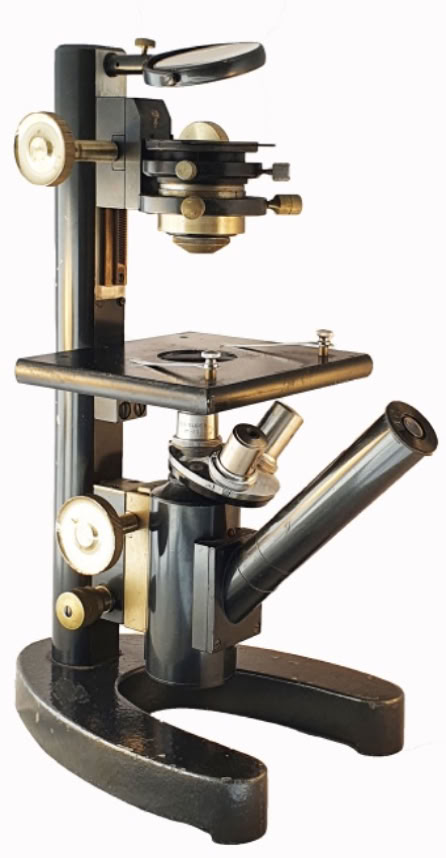
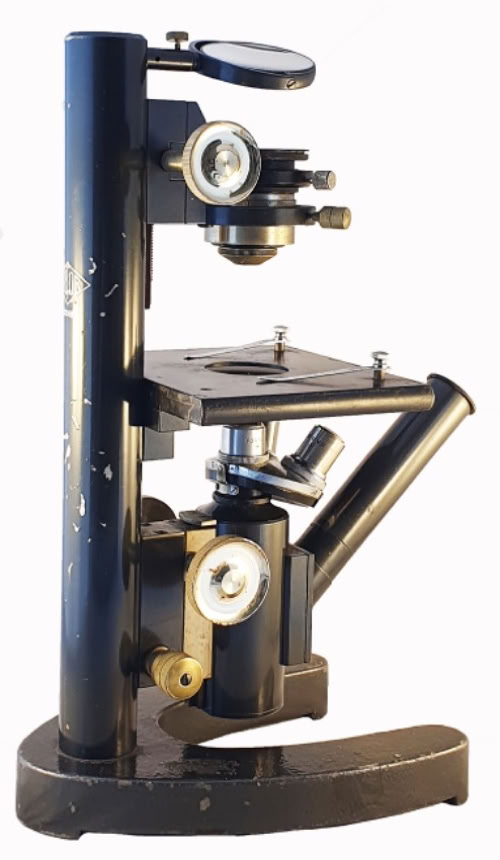
Microscope 506 was manufactured by W. R. Prior and dates from the 1960s. The instrument is engraved ‘PRIOR’ and bears the serial number 23304. This microscope was designed for applications including the examination of tissue cultures and specimens in freshwater and marine biology, particularly plankton. The instrument was available with a rack-and-pinion substage, a monocular or binocular body and a plain stage. Illumination was provided by an external light source, with different options available. These included a daylight configuration using a mirror, or a detachable substage lamp (Figure 1).
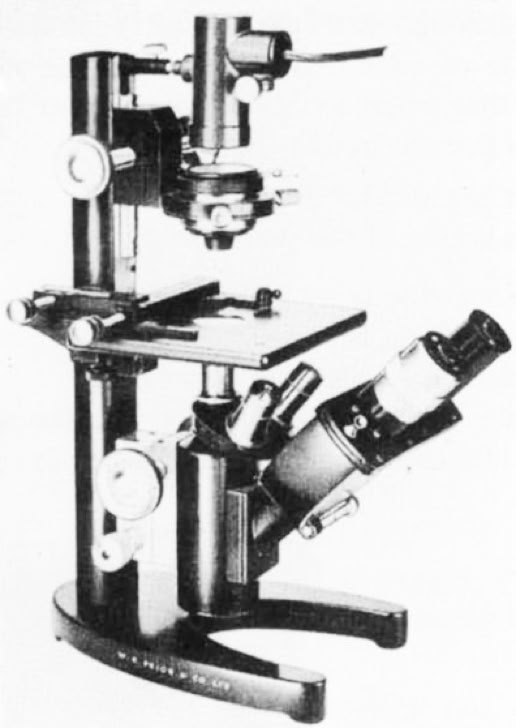
Figure 1. Prior’s inverted microscope with a substage lamp and binocular body as featured in a 1963 catalogue of the firm.