

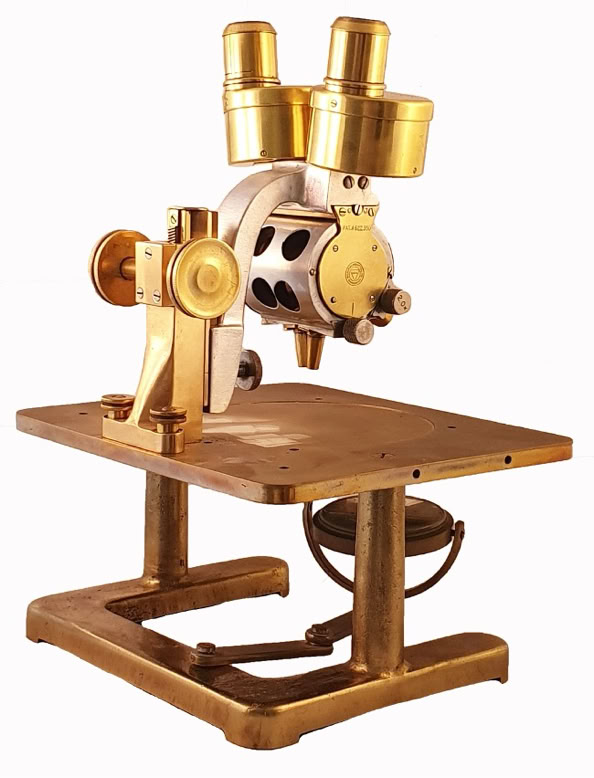
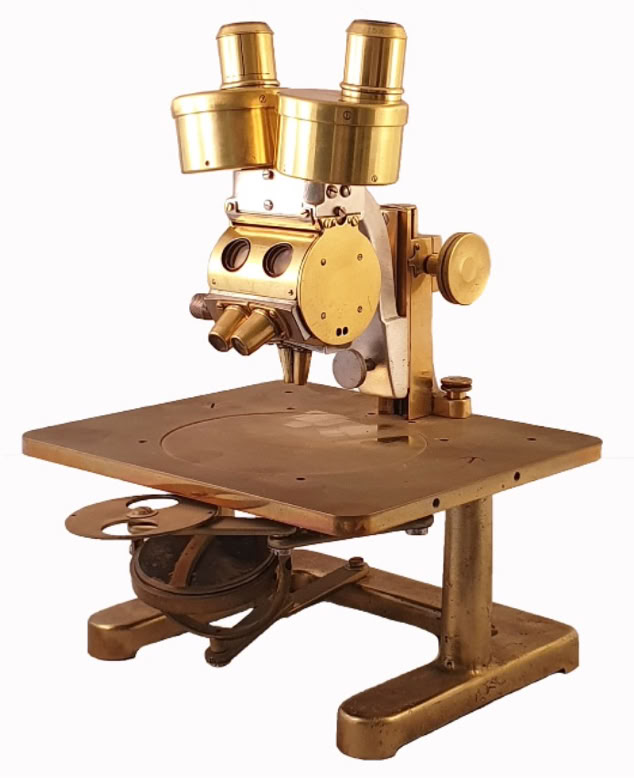
Microscope 453
(Bausch & Lomb; stereoscopic microscope with drum nosepiece; c. 1927)
Bausch & Lomb was founded by two German immigrants, Jacob Bausch and Henry Lomb. Bausch, who had trained as both an optician and a woodworker, established the business in partnership with Lomb, and the company initially achieved success through the manufacture of hard-rubber eyeglass frames. This provided the foundation for its subsequent expansion into other areas of optical manufacturing, including microscopes. Jacob Bausch's son, Edward, learned the skills of microscope manufacture, and the company further developed its business following the introduction of its own microscopes. The first patent granted to Bausch & Lomb, in 1865, concerned a relatively simple linen-prover microscope. Around 1874, the company began manufacturing both simple and compound microscopes. In 1890, Edward Bausch approached the German optical manufacturer Carl Zeiss, eventually negotiating an agreement under which Bausch & Lomb obtained a licence to use Zeiss patents, with exclusive rights for the United States market. In 1907, Zeiss acquired a 20% shareholding in Bausch & Lomb, further strengthening the relationship and granting the American company continued access to Zeiss optical patents. In 1915, however, Zeiss sold its shareholding back to Bausch & Lomb. The two companies subsequently had no formal business relationship until 1921, although Bausch & Lomb continued to make use of technologies covered by Zeiss patents. Jacob Bausch died in 1926, and Edward Bausch succeeded him as chairman of the board. In 1937, Bausch & Lomb became a publicly traded company. In 1987, Cambridge Instrument Company acquired Bausch & Lomb's optical systems division. In 1990, Cambridge Instrument Company merged with Wild Leitz to form the Leica group.
Microscope 453 is a stereoscopic microscope engraved with “BAUSCH & LOMB OPTICAL CO., Rochester, N.Y., U.S.A.” and the serial number 205236. The instrument is dated to approximately 1927. Its binocular head is additionally engraved with “PAT. 1622350”, referring to a United States patent granted to Bausch & Lomb in March 1927. The patent describes an improved mechanism for varying the magnification of a binocular microscope head (Figure 1). This magnification mechanism was incorporated into the Bausch & Lomb KW wide-field binocular microscope, which featured a drum-type nosepiece and could be fitted to different microscope stands (Figure 2). However, the specific model or origin of the stand fitted to microscope 453 has not been established.
Note: This instrument was kindly donated by Dave Levell (Pembrokeshire, Wales) in May 2023.

Figure 1. Illustrations describing the Bausch & Lomb’s improved mechanism for varying the magnification power of microscope binocular heads, as featured in USA Patent 622350.
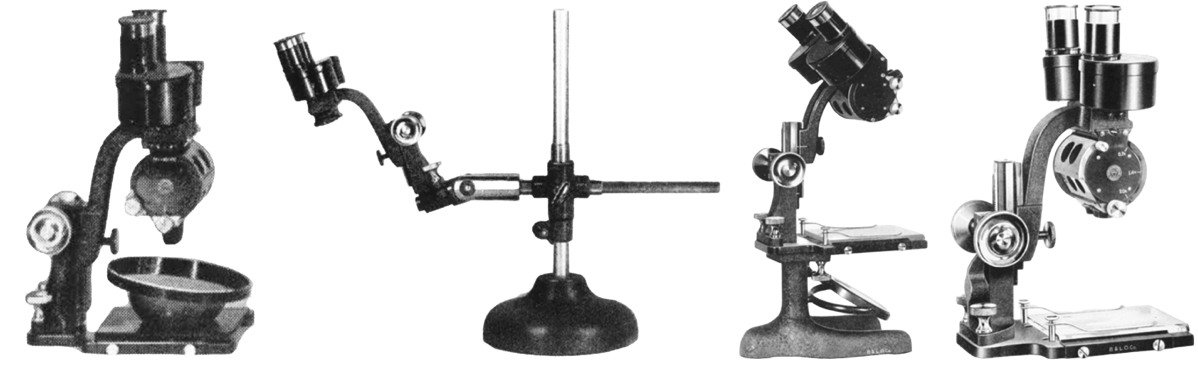
Figure 2. KW wide field binocular microscope with drum nosepiece used with different stands, as featured in a Bausch & Lomb’s 1930s catalogue.