

Microscope 42
(C Collins; student microscope; c. 1880)
Charles Collins manufactured microscopes and other optical instruments from 1863 until the early twentieth century. The spring 1861 census recorded the 23-year-old Collins as an optician living with his parents in Croydon, Surrey. He appears to have established his own retail business and workshop in central London in 1863. He joined the Quekett Microscopical Club in 1865 and the Royal Microscopical Society in 1866. The sixth edition of Hogg's The Microscope, published in 1867, featured several instruments made by Collins, including a binocular student's microscope and the Bockett lamp. Monocular versions of the student's microscope were subsequently produced. In early 1871, Collins relocated his retail premises to Great Portland Street, just a short walk from his previous shop. Signs of decline in Collins's business are evident by the early 1890s. The 1911 census described him as an optician, sight testing, spectacles, suggesting that his work had by then shifted towards eyesight testing and the fitting of spectacles rather than the manufacture of microscopes.
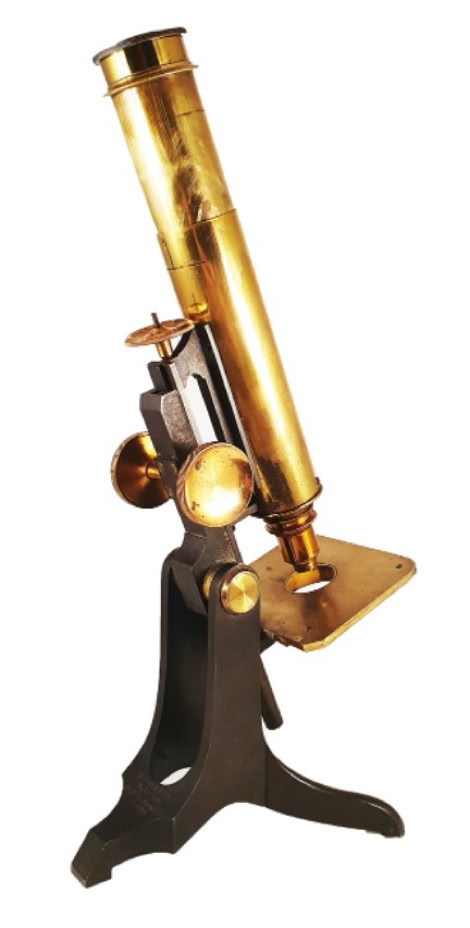
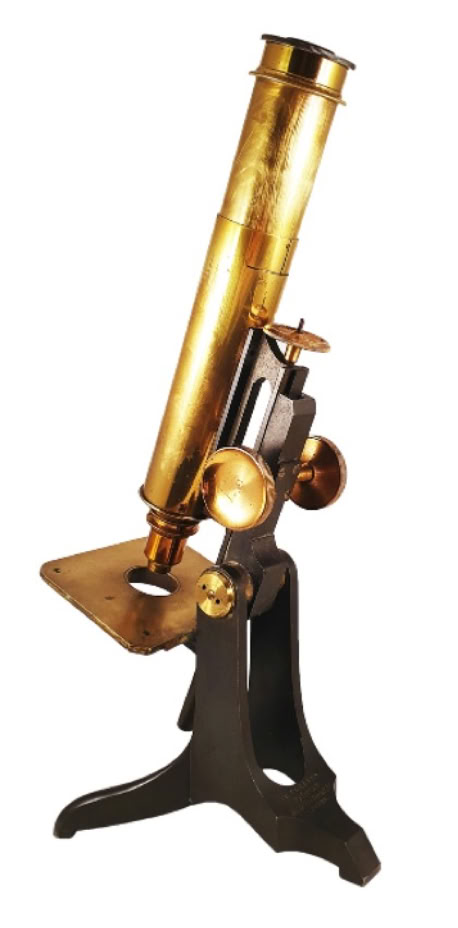
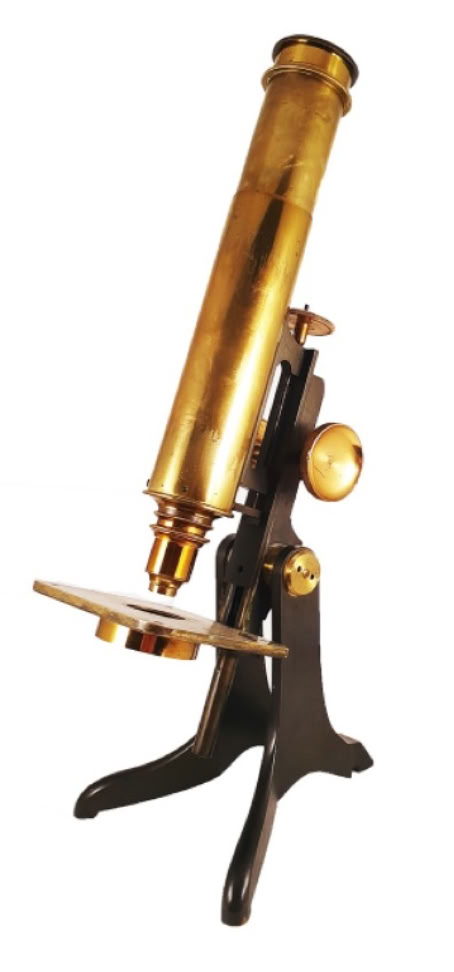
Microscope 42 is a monocular version of Collins's student's microscope, dating from around 1880 (Figure 1). The base is engraved with the inscription C. Collins, Optician, 157 Gt. Portland St., London. The instrument has a lacquered brass finish, with black-oxidised brass on the base and limb. Coarse focusing is achieved by a rack-and-pinion mechanism, while fine focusing is controlled by a wheel at the top of the limb. A distinctive feature of Collins's microscopes was the unusually large diameter of the body tube, designed to allow eyepieces to be interchanged between his different models.
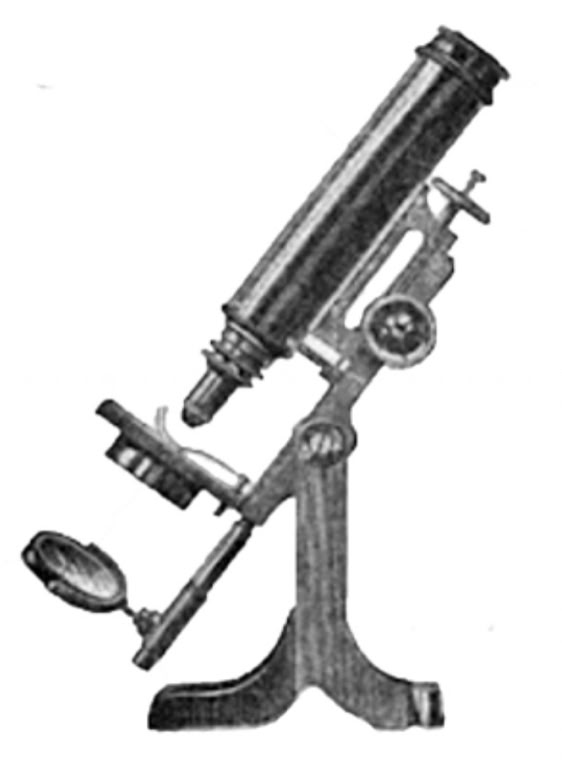
Figure 1. A later version of the Collins’s student monocular microscope as appeared in an 1880 advertisement in the Journal of the Royal Microscopical Society.