


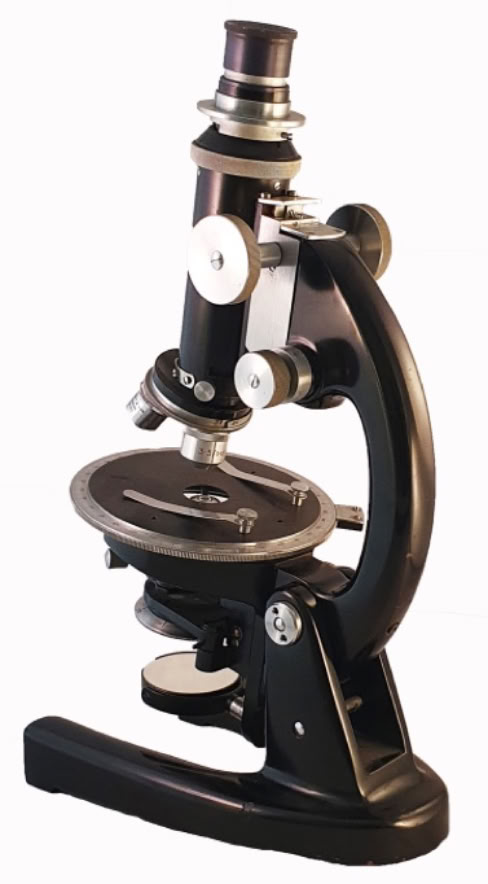

Microscope 411
(J Swift; polarising microscope, model P; 1950s)
James Swift was a microscope maker based in London. The company was founded in 1853 by James Powell Swift, the son of watchmaker Thomas Swift. Before establishing his own business, James Swift had served an apprenticeship with the renowned microscope maker Andrew Ross. In 1881, the firm introduced several improvements to microscope design, including replacing the conventional straight rack-and-pinion focusing mechanism with helically cut components and introducing a new fine-focusing system. In 1884, Mansell James Swift, the founder's son, joined the business, which subsequently became known as James Swift & Son. In 1901, Swift supplied microscopes for use aboard the R.R.S. Discovery during Captain Scott's Antarctic expedition of 1901–1904. These instruments were listed in the company's contemporary catalogue as the 'Discovery' model. In 1903, Mansell Powell John Swift, the founder's grandson, also joined the firm. James Powell Swift died in 1906, and in 1912 the business was incorporated as a limited company under the name J. Swift Ltd. In 1942, both Mansell James and Mansell Powell died. Four years later, in 1946, the company was acquired by E. R. Watts & Son Ltd, largely as a result of the longstanding association between the Watts and Swift families. In 1949, John H. Basset joined the company and subsequently took it over in 1968.
Microscope 411 is a J. Swift polarising microscope, Model P (Figure 1), bearing the serial number 28404. Based on its serial number and design, the instrument should be dated to the 1950s. It is also engraved with the inscription “UNIV READING, GEOL DEPT, Nº 76”, indicating its former use in the Geology Department of the University of Reading.
Note: This instrument was kindly donated by Dave Levell (Pembrokeshire, Wales) in May 2023.

Figure 1. Swift’s polarising microscope as featured in a 1960 Gallenkamp’s catalogue.