


Microscope 369
(Bausch & Lomb; StereoZoom 4 microscope; 1960s)
Bausch & Lomb was founded by two German immigrants, Jacob Bausch and Henry Lomb. Bausch, who had trained as both an optician and a woodworker, initially established the business with Lomb in the United States. The company first achieved commercial success through the manufacture of eyeglass frames made from hard rubber. This success enabled it to expand into other areas of optical manufacturing, including microscopes. Jacob Bausch's son, Edward, learned the art of microscope making, and the company prospered following its entry into this field. In 1865, Bausch received his first patent, for a simple microscope of the linen-prover type. By approximately 1874, the company had begun manufacturing both simple and compound microscopes. In 1890, Edward Bausch approached the German optical manufacturer Carl Zeiss, eventually securing a licensing agreement that allowed Bausch & Lomb to use Zeiss patents, with exclusive rights to the US market. In 1907, Zeiss acquired a 20% share in Bausch & Lomb, granting the American company continued access to its patents. This arrangement ended in 1915, when Zeiss sold its shareholding back to Bausch & Lomb. Although the two companies had no further direct business dealings until 1921, Bausch & Lomb continued to benefit from the use of Zeiss patents. Following Jacob Bausch's death in 1926, Edward Bausch became chairman of the board. In 1937, the company became publicly traded. In 1987, Bausch & Lomb's optical systems division was acquired by Cambridge Instruments, which continued to operate it under the Cambridge Instruments name. In 1990, Cambridge Instruments merged with Wild-Leitz to form Leica plc.
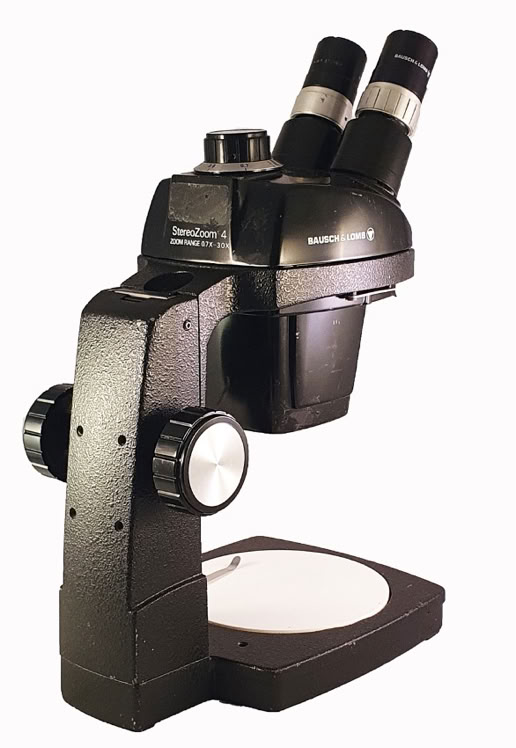
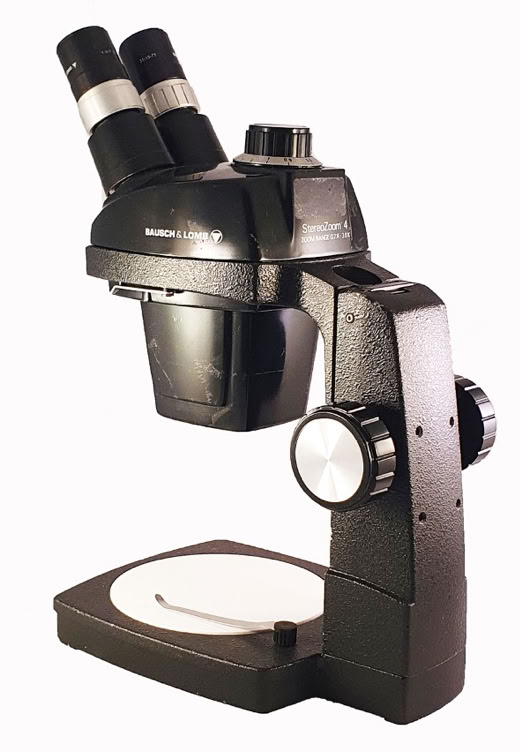
Microscope 369 is a Bausch & Lomb StereoZoom 4 stereomicroscope (Figure 1). The instrument bears the company name and its distinctive triangular logo, a design used between 1965 and 1978. It is also marked “StereoZoom 4, ZOOM RANGE 0.7X–3.0X”, indicating a variable magnification range of 0.7× to 3.0×.
Note: This instrument was kindly donated by Dave Levell (Pembrokeshire, Wales) in May 2023.
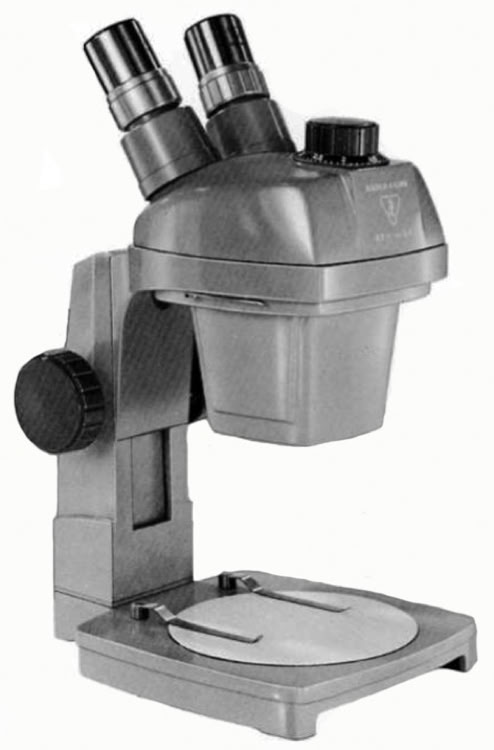
Figure 1. Bausch & Lomb’s StereoZoom 4 microscope as engraved in a 1960s catalogue of the firm.