

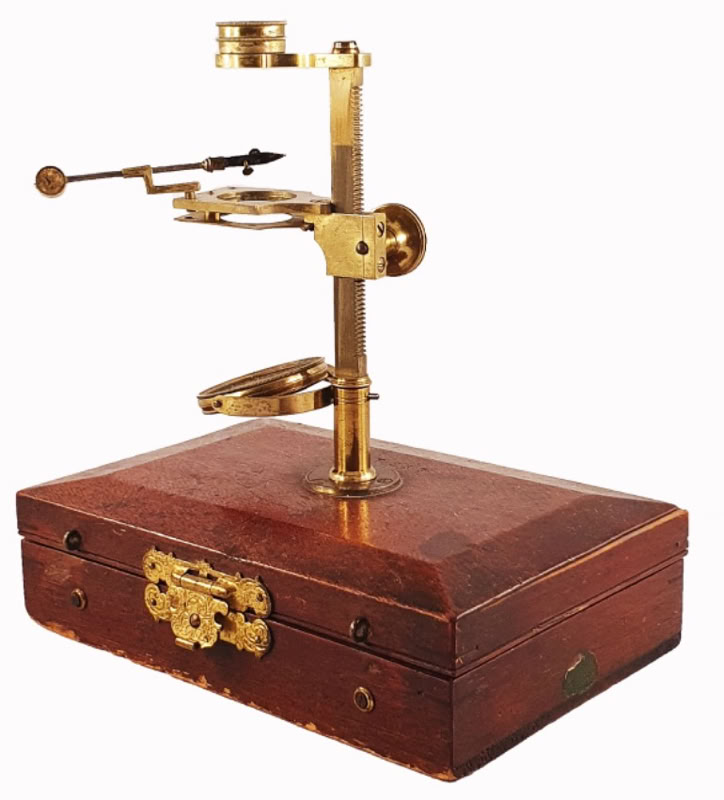
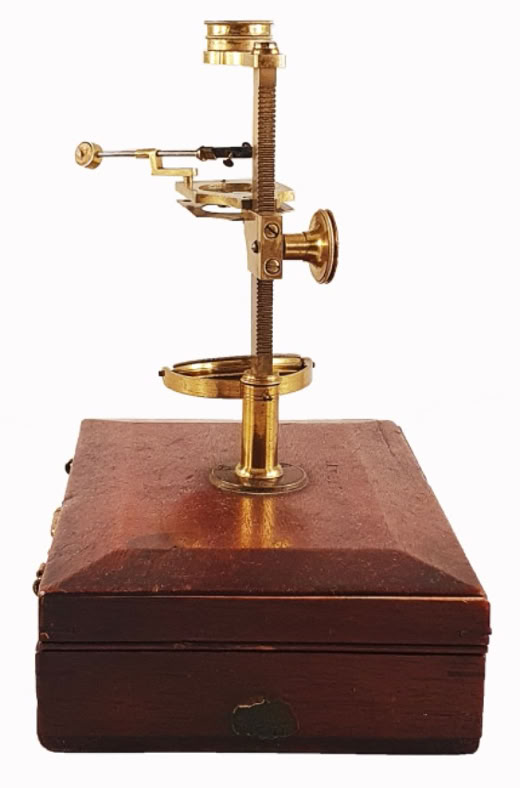
Microscope 322
(unassigned maker; aquatic/botanical microscope; first half of the 19th century)
Microscope 322 is a simple aquatic or botanical microscope, probably manufactured in England during the first half or middle of the nineteenth century. The maker is unknown. The instrument consists of a stem that screws securely into the lid of its storage case, allowing the microscope to be assembled for use and packed away when not required. Microscopes of this type were designed for examining botanical specimens, small insects and their anatomical parts, as well as for preparing and dissecting specimens. Aquatic organisms could also be observed using a suitable live-specimen chamber. The design follows the tradition of the ‘botanical’ or ‘aquatic’ microscopes developed by John Cuff and George Ellis, which provided a portable and versatile means of conducting simple microscopic observations (Figure 1).
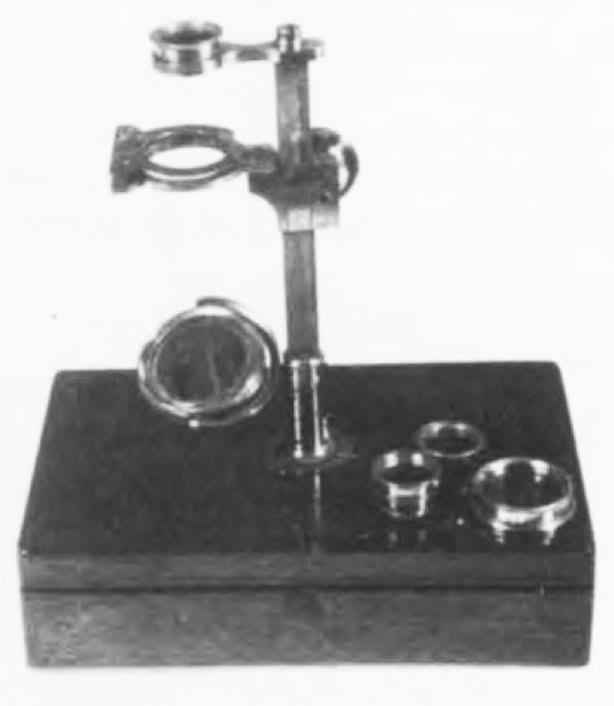
Figure 1. Aquatic microscope made by R. Field in 1855, as featured in Brown (1986) The Whipple Museum of the History of Science, Catalogue 7 – Microscopes.