

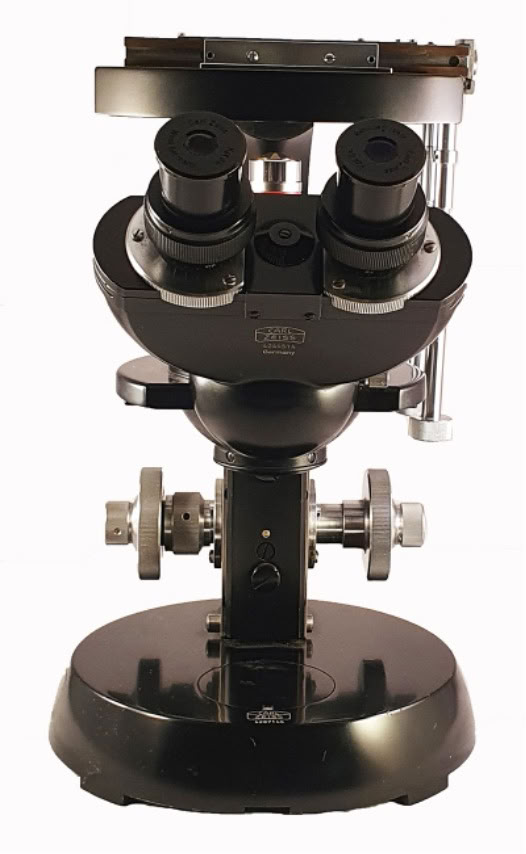

Microscope 316
(Carl Zeiss; inverted microscope; 1960s)
In 1846, Carl Zeiss established a workshop for precision mechanics and optical instruments in Jena, Germany. The business increasingly concentrated on microscope manufacturing and soon expanded beyond the regional market, exporting instruments internationally. In 1866, Zeiss recruited the physicist Ernst Abbe to improve the optical performance of his microscopes. Abbe became a partner in 1877 and made fundamental contributions to the scientific development of microscope optics. Following Carl Zeiss’s death in 1888, Abbe established the Carl Zeiss Foundation in 1889. The foundation subsequently became the company’s sole owner. From the 1890s onwards, Abbe’s scientific discoveries and systematic approach to research and development drove innovation across other areas of optics, resulting in new products, expanded business activities and substantial growth. The company opened its first foreign subsidiary in London in 1893 and established an international network of operations before the First World War. Many of these overseas activities were disrupted or closed following the outbreak of war. The company subsequently experienced further upheaval, particularly during the Second World War and the division of Germany. After 1945, its operations developed along separate paths in East and West Germany, before eventually being reunited following German reunification. Today, Carl Zeiss AG is an international technology group comprising several subsidiaries, with major operations in Germany and manufacturing and research facilities across Europe, the United States and Asia.
Microscope 316 is an inverted microscope manufactured by Carl Zeiss. The stand bears the serial number 4287145, and the instrument can be dated to approximately the 1960s.