
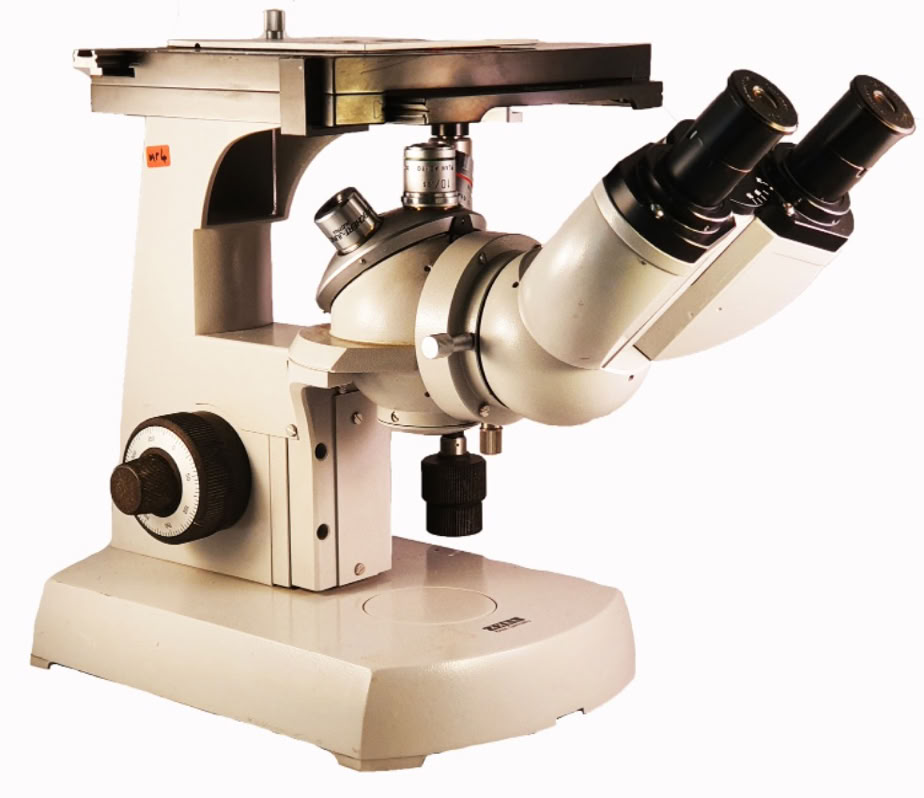
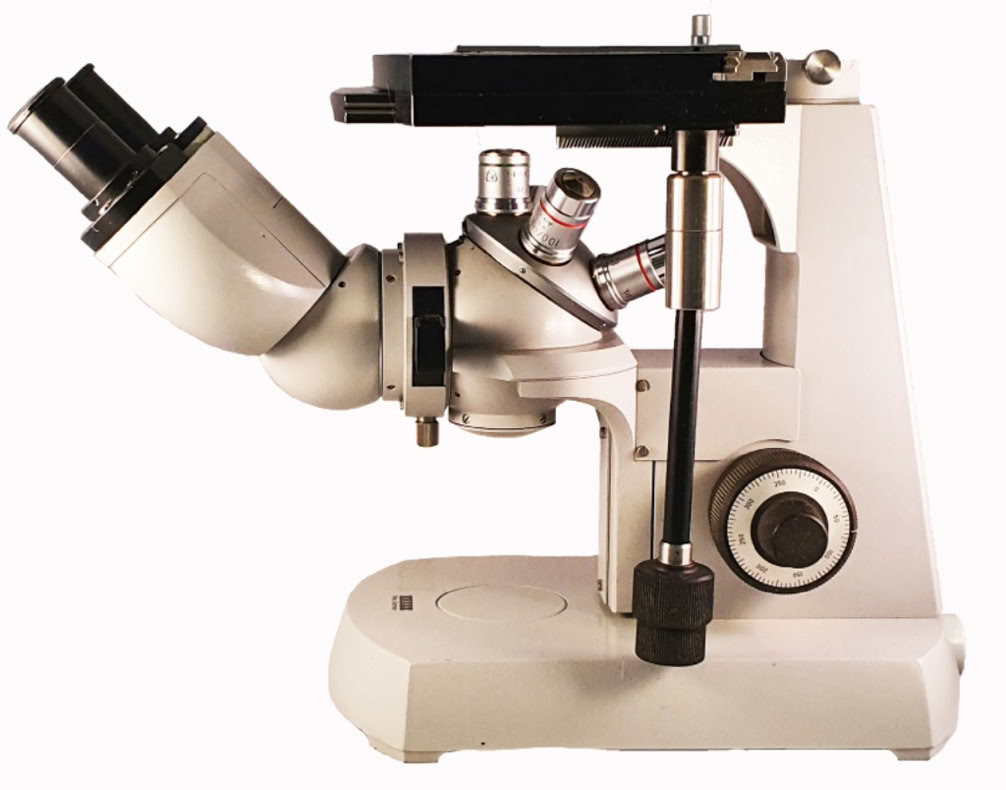
Microscope 313
(Carl Zeiss; microscope invertoscope D; 1980s)
In 1846, Carl Zeiss established a workshop for precision mechanics and optical instruments in Jena, Germany. The business increasingly concentrated on microscope manufacturing and soon expanded beyond the regional market, supplying instruments internationally. In 1866, Zeiss recruited the physicist Ernst Abbe to improve the optical performance of his microscopes. Abbe became a partner in 1877 and made fundamental contributions to the scientific development of microscope optics. Following Carl Zeiss’s death in 1888, Abbe established the Carl Zeiss Foundation in 1889. The foundation subsequently became the company’s sole owner, establishing a distinctive model of corporate ownership. From the 1890s onwards, Abbe’s scientific findings and systematic approach to research and development helped drive innovation across other areas of optics, leading to new products, expanded business activities and substantial growth. The company opened its first foreign subsidiary in London in 1893. Before the outbreak of the First World War, it had established a network of international operations, many of which were closed during the conflict. The company subsequently experienced further disruptions, particularly during the Second World War and the division of Germany. Following the war, its operations developed along separate paths in East and West Germany. International expansion resumed, and Carl Zeiss eventually evolved into a corporate group comprising multiple subsidiaries. Today, Carl Zeiss AG operates internationally, with major activities in Germany and manufacturing and research facilities across Europe, the United States and Asia.
Microscope 313 is a Carl Zeiss inverted microscope, model Invertoscope D, manufactured in West Germany. The stand is engraved with the numbers ‘47300’ and ‘47 12 81 – 0000/14’, while the binocular head bears the marking ‘47 30 12 – 9902’. These inscriptions provide identifying information for the instrument and its components. The microscope probably dates from the 1980s.