
Microscope 292
(R & J Beck; Luminex microscope; 1930s)
R. & J. Beck occupies an important place in the history of British microscope manufacturing. The company's origins date to 1847, when Richard Beck (1827–1866) entered into partnership with James Smith (1800–1873), an optical instrument maker based in London. Richard's brother, Joseph Beck, subsequently joined the business, which eventually became known as R. & J. Beck. Richard and Joseph Beck were nephews of Joseph Jackson Lister, the British optician and physicist renowned for his pioneering work on achromatic lenses and the development of improved compound microscopes. Lister commissioned James Smith, then working for the instrument-making firm of William Tulley, to construct a microscope stand for his improved optical system. Smith established his own optical instrument workshop in 1837, and, through Lister's connections, Richard Beck began an apprenticeship with him in 1843. In 1847, Smith and Richard Beck formed a partnership under the name Smith & Beck. The firm's name changed to Smith, Beck and Beck in 1854, following Joseph Beck's entry into the business in 1851. James Smith retired in 1865, and the company adopted the name R. & J. Beck, which it retained for many decades. Following Richard Beck's premature death in 1866, aged 39, Joseph continued to run the business. In 1895, the company became a limited company, R. & J. Beck Ltd. By 1968, it was a subsidiary of the American Ealing Corporation. Beck Optronic Solutions Ltd, established much later, is a successor to the former R. & J. Beck business.
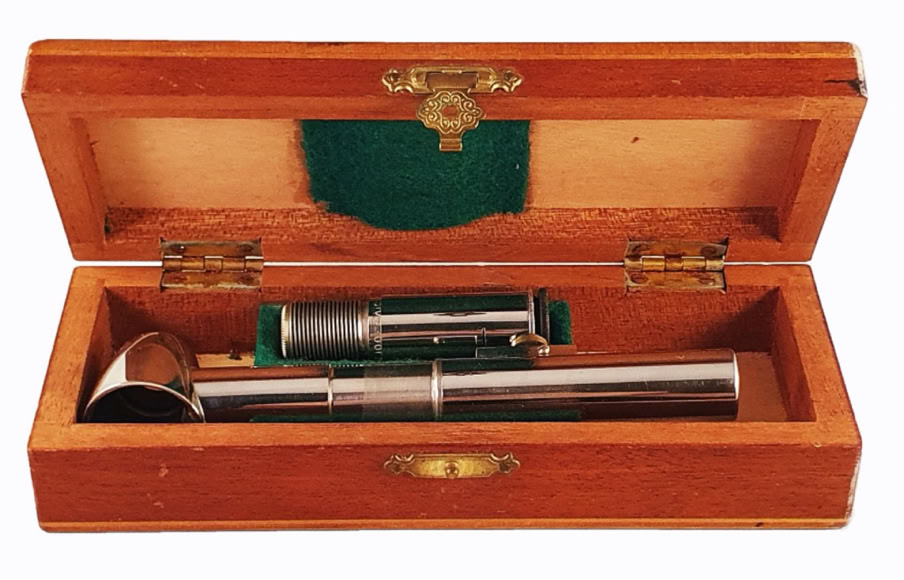
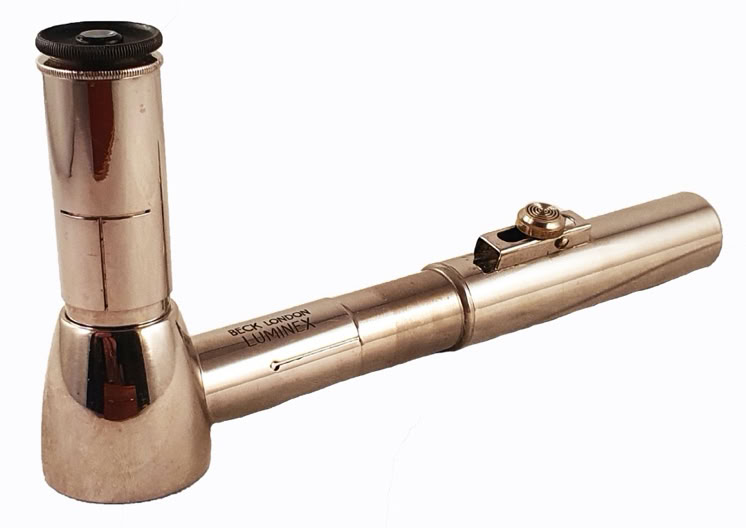
Microscope 292 is a Beck Luminex microscope, dating from the 1960s (Figure 1). The Luminex range comprised compact optical instruments with an integrated illumination system, in which light was concentrated onto the specimen by a specially shaped reflector. The company produced fixed-focus Luminex magnifiers providing approximately 10× magnification, with the specimen positioned just below the rim of the reflector. Other models offered higher magnifications and incorporated a focusing mechanism. This instrument follows the same basic principle but differs from the simpler magnifiers by incorporating a compound microscope assembly that provides 40× magnification. The eyepiece also contains a graduated scale, allowing measurements to be made within the field of view.

Figure 1. Beck’s Luminex illuminating magnifier (left) and Luminex microscope (right) as pictured in the 1930 book ‘Beck microscopes’ by Richard Beck and Joseph Beck.