
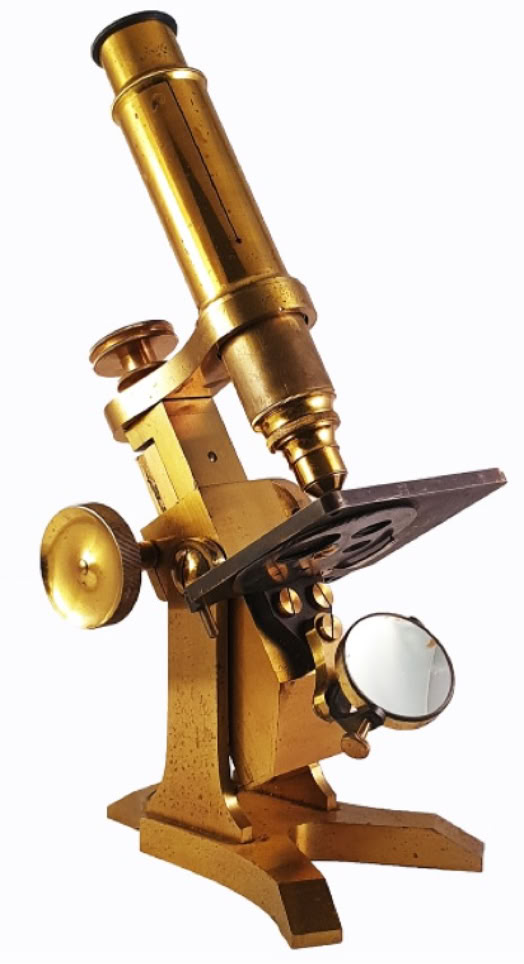
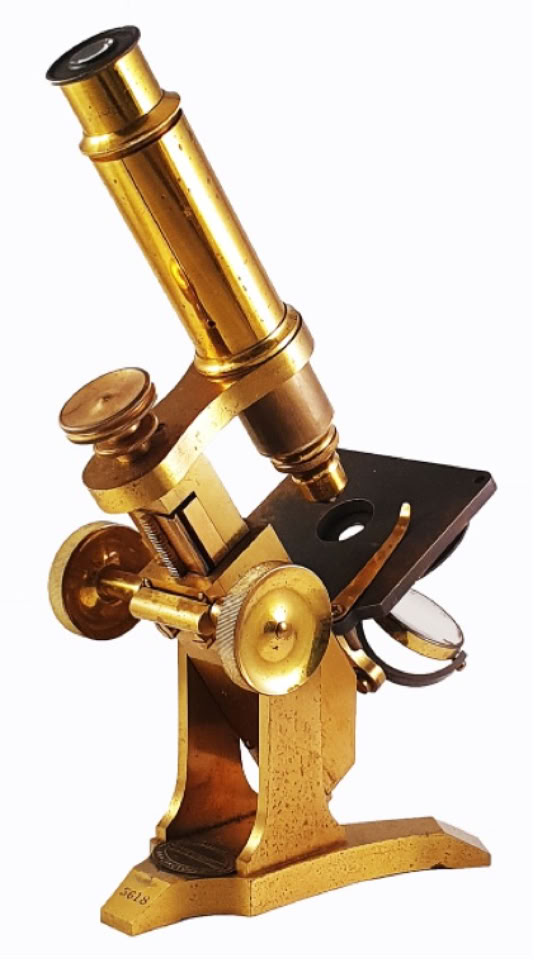
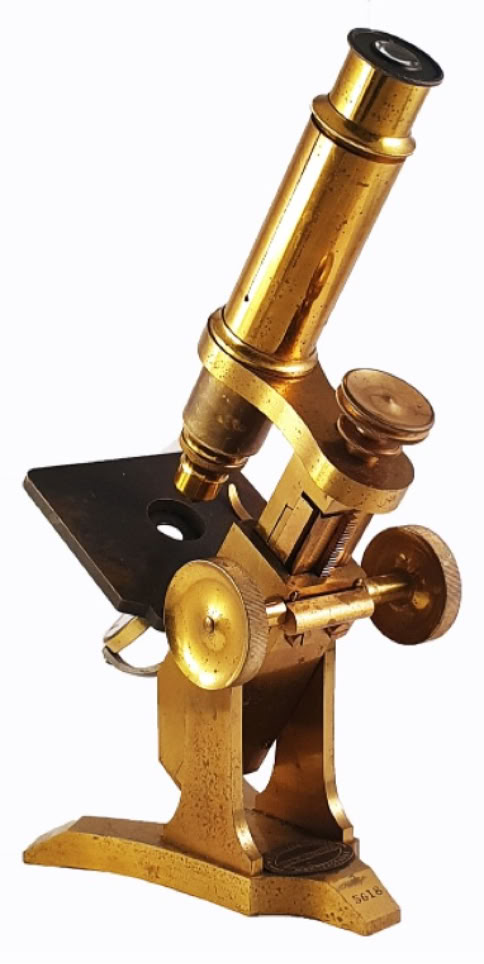
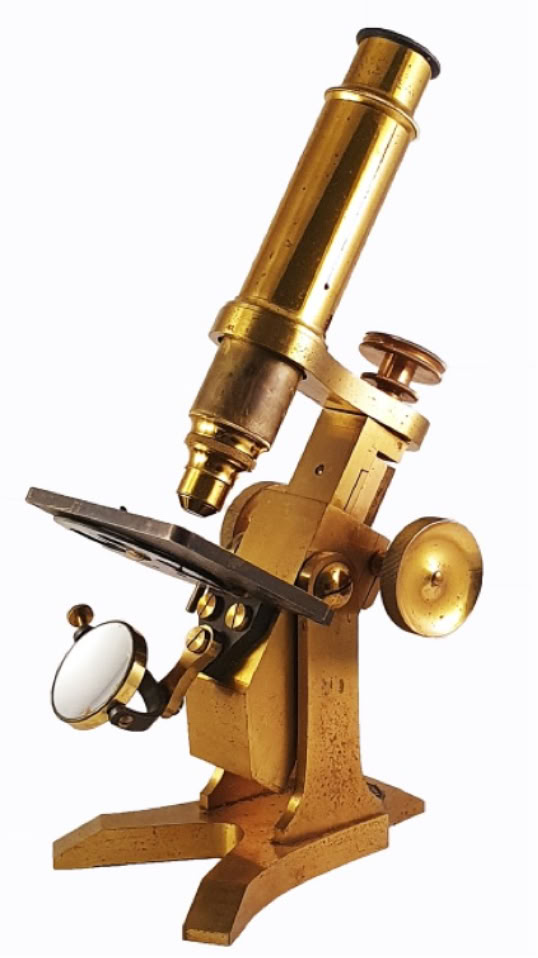
Microscope 202
(Pillischer; ‘The International’ microscope, c. 1880)
Moritz (M.) Pillischer emigrated from Hungary to London, England, in 1845. Around 1849, he established an independent optical business specialising in microscopes and other scientific and mathematical instruments. Initially located at 419 Oxford Street, London, the business moved to 398 Oxford Street before the spring of 1851, and subsequently to 88 New Bond Street in 1853. Pillischer’s nephew, Jacob, who adopted the name James, moved to London around 1860 to work for his uncle. He later became Pillischer’s son-in-law after marrying one of his daughters. Until 1854, Pillischer supplied French-made objectives with his microscopes rather than manufacturing his own lenses. He was elected a Fellow of the Royal Microscopical Society in 1855 and joined the Quekett Microscopical Club in 1869. By 1881, Moritz had moved to Hove, Sussex, although he retained ownership of the optical business. In 1887, he transferred ownership to Jacob, and he died at his home in Sussex in 1893. Jacob subsequently joined the Quekett Microscopical Club in 1895 and the Royal Microscopical Society in 1898. Following Jacob’s death in 1930, the business passed to his three children, Edward, Leopold and Bertha. The firm was eventually liquidated in 1947.
Microscope 202 bears the inscriptions ‘M. Pillischer, London’, ‘Trade Mark’, ‘Manufacturer’ and ‘The International’, together with the serial number 3618. The name ‘International’ refers to the instrument’s distinctive body tube, which conforms to the English standard length but can be extended to the Continental standard length. Introduced by Pillischer in 1876, the International microscope represents an example of his late 19th-century instrument design. The instrument can be dated to approximately 1880 (Figure 1).
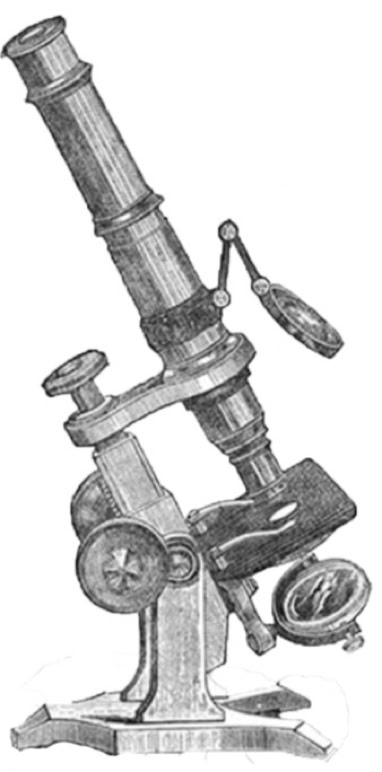
Figure 1. The Pillischer’s ‘International’ Microscope as pictured in an advertisement in The Lancet in 1876.