
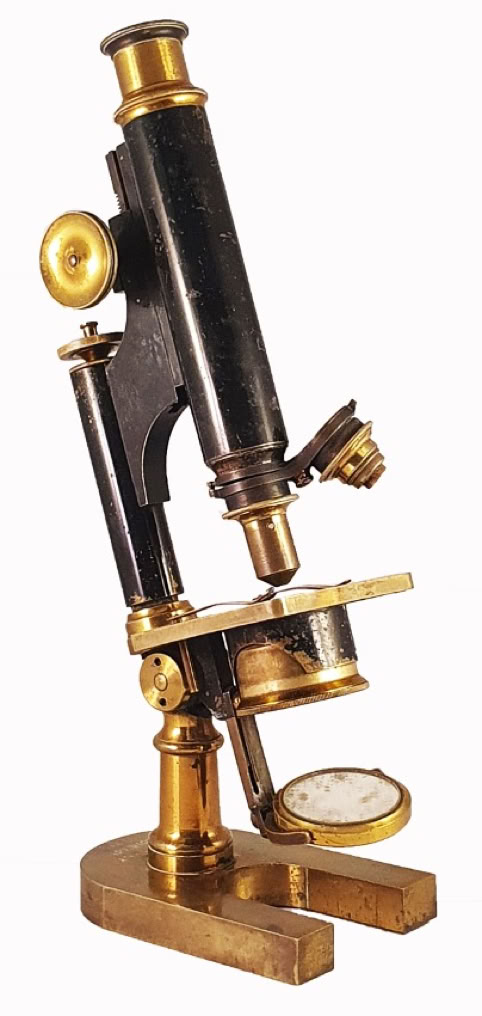

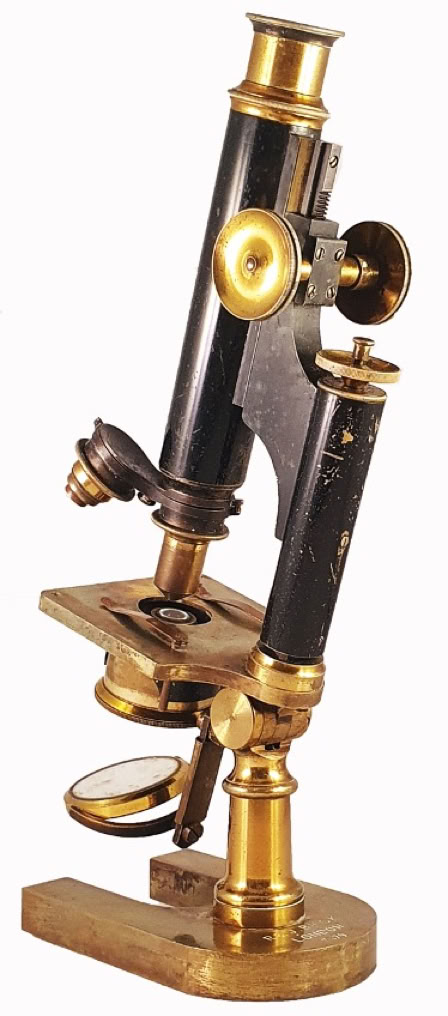

Microscope 195
(R & J Beck; economic stand microscope; c. 1878)
R & J Beck occupies an important place in the history of British microscope manufacturing. The company originated in London through the partnership of Richard Beck (1827–1866) and James Smith (1800–1873), and was later joined by Richard’s brother, Joseph Beck. Richard and Joseph Beck were nephews of Joseph Jackson Lister, a distinguished British optician and physicist renowned for his work on achromatic lenses and his contributions to the development of the optical microscope. When commissioning the manufacture of his improved microscope, Lister collaborated with James Smith, then employed by the instrument-making firm of William Tulley, to construct the microscope stand. Smith subsequently established his own optical instrument workshop in 1837. Through Lister’s influence, his nephew Richard Beck became an apprentice to Smith in 1843. In 1847, Smith entered into partnership with Richard Beck, and the business was renamed Smith & Beck. In 1854, following Joseph Beck’s arrival in the company in 1851, the name changed to Smith, Beck & Beck. James Smith retired in 1865, and the firm adopted the name R & J Beck, under which it operated for many decades. Following Richard Beck’s premature death in 1866, aged just 39, Joseph continued to run the business. In 1895, the company became a limited company under the name R & J Beck Ltd. By 1968, it had become a subsidiary of the American Ealing Corporation. In 2019, Beck Optronic Solutions Ltd represented a descendant of the original R & J Beck enterprise.
Microscope 195 bears the inscription ‘R & J Beck, London’ and carries serial number 7579, dating the instrument to approximately 1878. It belongs to Beck’s Economic microscope model range, which was introduced in the late 1870s and remained in production until at least 1894. The model was available with either a simple sliding mechanism for coarse focusing or a rack-and-pinion mechanism, as fitted to this example. Both versions of the Economic microscope could be supplied with either a tripod foot or a horseshoe-shaped foot (Figure 1). Customers could also choose between a fully lacquered brass finish and an oxidised brass finish. This microscope retains its original wooden storage case. At some point in its history, a previous owner modified the instrument by cutting the original mirror arm and extending it with a handmade brass adaptor. This alteration represents a later modification to the microscope’s original construction.

Figure 1. Beck’s Economic microscope model with a tripod foot (left; Beck’s catalogue from 1882) and a horseshoe foot (Right; James Queen’s catalogue from 1879)