


Microscope 18
(R & J Beck; new star microscope; c. 1890)
R & J Beck occupies an important place in the history of British microscope manufacturing. The company originated in London through a partnership between James Smith (1800–1873) and Richard Beck (1827–1866), who was later joined by his brother Joseph Beck. Richard and Joseph were nephews of Joseph Jackson Lister, a distinguished British optician and physicist renowned for his work on achromatic lenses and his contributions to the development of the compound optical microscope. When Lister commissioned the manufacture of an improved microscope based on his optical designs, he worked with James Smith, then employed by the instrument-making firm of William Tulley, to produce the microscope stand. Smith subsequently established his own optical instrument workshop in 1837. Through his family connection with Lister, Richard Beck was apprenticed to Smith in 1843. In 1847, Smith entered into partnership with Richard Beck, and the business became Smith & Beck. Following Joseph Beck’s arrival in 1851, the company was renamed Smith, Beck and Beck in 1854. Smith retired in 1865, and the business adopted the name R & J Beck, which it retained for many decades. Richard Beck died prematurely in 1866, aged 39, leaving Joseph to continue running the business. In 1895, the company became a limited company under the name R & J Beck Ltd. By 1968, it had become a subsidiary of the American Ealing Corporation. In 2019, Beck Optronic Solutions Ltd was identified as a descendant of the former R & J Beck business.
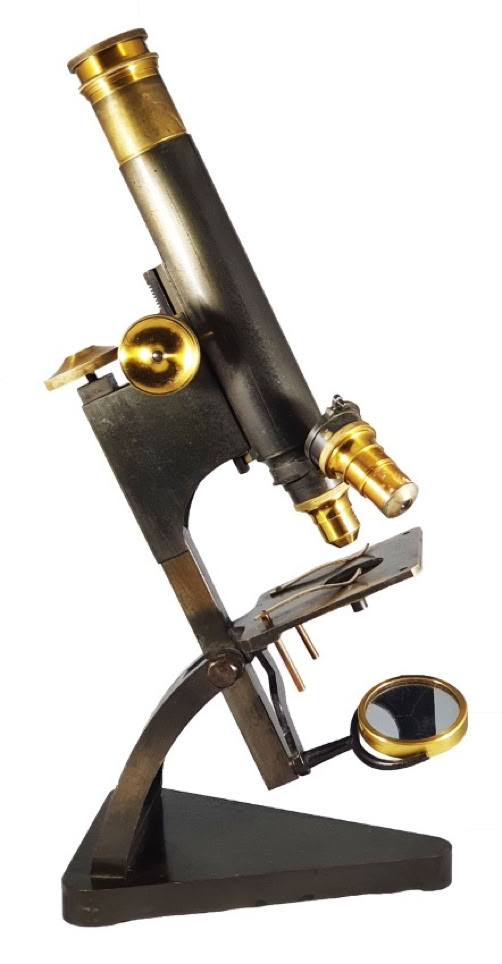
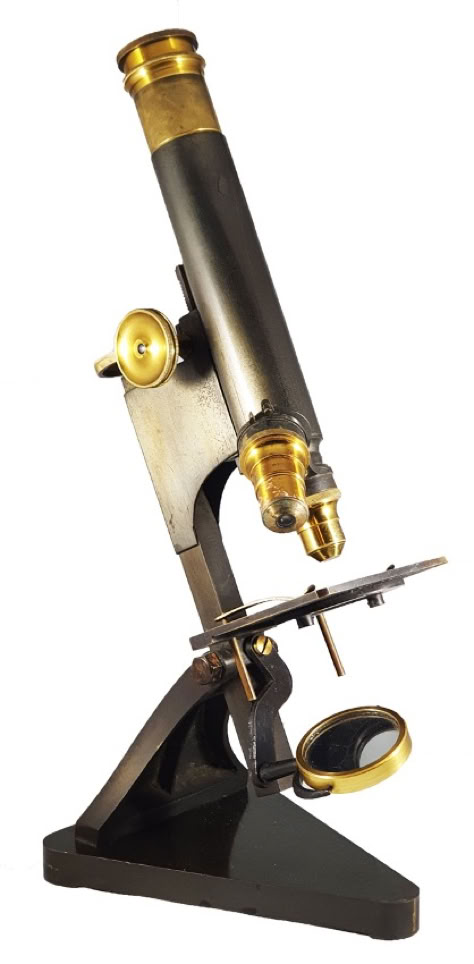
Microscope 18 dates from around 1890 and is an example of Beck’s New Star model (Figure 1). Its main components are constructed from black-finished and lacquered brass. The instrument features rack-and-pinion coarse focusing and fine focusing operated by a knurled knob connected to a micrometer screw. A removable iris diaphragm screws into the underside of the stage. The plane-concave mirror is mounted on an articulated arm attached to the limb, allowing it to be swung over the stage to provide oblique illumination. The original wooden case bears a label inscribed: ‘G. T. W. NEWSHOLME, pharmaceutical chemist, 74 Market Place, SHEFFIELD’. This suggests that the microscope was either owned by or supplied through the business of George Thomas Wilkinson Newsholme, a distinguished pharmacist who served as president of the Pharmaceutical Society of Great Britain, the forerunner of the Royal Pharmaceutical Society, in 1901. The instrument bears serial number 17000. The New Star model succeeded an earlier design introduced in 1885, which featured a cast-iron base and a nickel-plated brass body.

Figure 1. Beck’s New Star model microscope (adapted from the ‘Illustrated catalogue of microscopes, object glasses and apparatus manufactured by R. & J. Beck Limited’, 1894).