

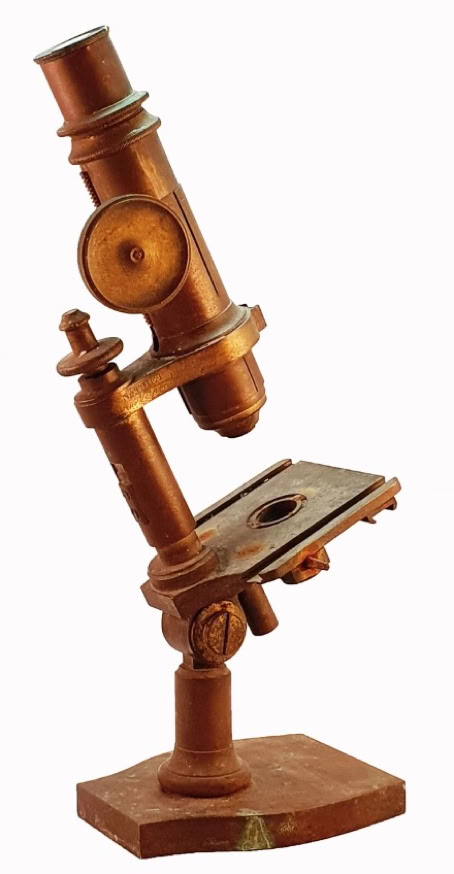

Microscope 170
(Nachet; Petit modèle; c. 1850)
Camille Sébastien Nachet (1799–1881) began his career working with Charles Chevalier before establishing his own optical business in 1839. At the time, Chevalier, Oberhaeuser and Nachet were among the principal microscope manufacturers in Paris. In the late 1850s, Nachet was joined by his son, Jean Alfred Nachet (1831–1908), known as Alfred. The firm was renamed Nachet et Fils around 1862, when Alfred became a partner. Following Camille’s death, Alfred continued the business under the name A. Nachet, used from approximately 1880 to 1890. When Alfred’s son joined the partnership around 1890, the firm once again became Nachet et Fils. By 1898, the company had also acquired Hartnack & Prazmowski and Bézu, Hausser et Cie. The business operated from several addresses over its history: Rue Serpente in Paris from 1839 to 1862, Rue Séverin in Paris from 1862 until after the Second World War, and Rue Chaptal 106 in Levallois-Perret during the 1970s.
Microscope 170 is engraved ‘Nachet Opticien, Rue Serpente 16, Paris’ and can be dated to around 1850. It is an example of Nachet’s petit modèle. The instrument requires restoration, and several components, including the mirror, are missing. The microscope stands on a solid, distinctively shaped foot supporting a short pillar and a robust inclination joint. The original substage mirror was mounted on a gimbal at the end of a tube that slid inside the fixed tailpiece. The substage incorporates a sliding plate designed to accommodate two apertures, both of which are now missing. The stage was designed to support a specimen slide, also absent from this example, which would slide along rails running in slots in the stage. Coarse focusing is achieved by push-pull movement of the body tube, while fine focusing uses a continental screw mechanism. A bull’s-eye condenser could be attached to the optical tube using a dovetail fitting. The petit modèle appeared in numerous Nachet catalogues over the years, with several modifications to its design (Figure 1). Over time, the original sliding plate with two apertures was replaced by a rotating aperture wheel, and the substage mirror became articulated. The arm supporting the bull’s-eye condenser was shortened, and the stage was simplified to use conventional specimen clips. The foot was also redesigned, eventually adopting the more familiar horseshoe shape.

Figure 1. Nachet’s petit modèle microscope as pictured in the firm’s catalogues over the years.