
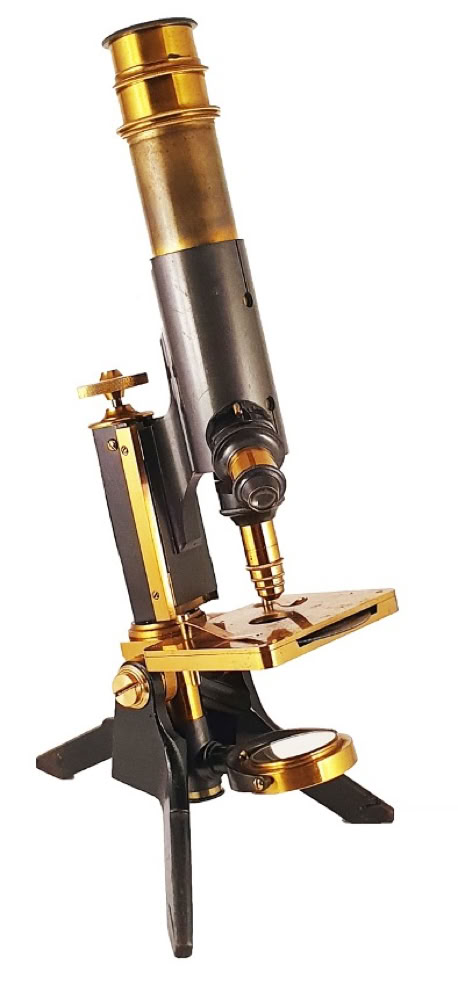

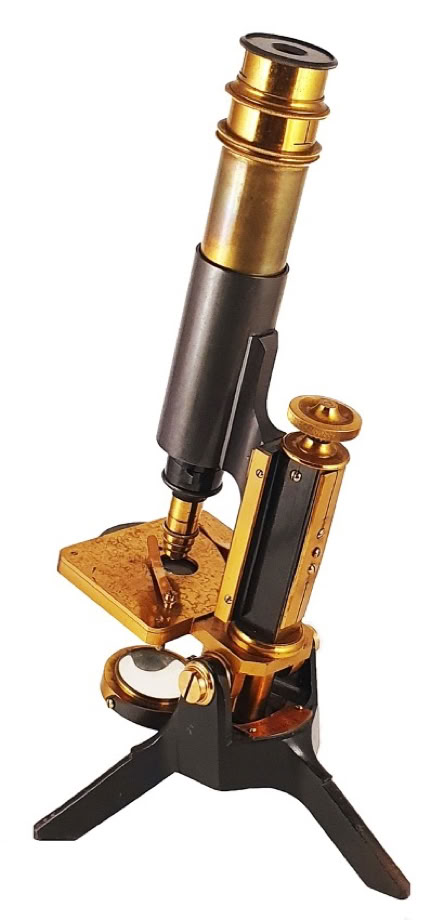

Microscope 16
(J Parkes & Son; worker microscope model; c. 1900)
Based in Birmingham, England, J. Parkes and Son produced microscopes, scientific instruments, and laboratory supplies from the mid-19th century into the 20th century. Recognising the growing market among students and middle-class amateur microscopists, the firm offered a range of relatively inexpensive instruments, making microscopy more accessible to a wider public. James Parkes established his business in 1815, initially manufacturing small items such as jewellery cases and other metal fittings. Around 1846, his only son, Samuel, joined him as a partner, and the business became known as J. Parkes and Son. By the 1850s, the firm was producing a variety of microscopes, and its 1857 catalogue featured microscopes and prepared slides prominently. Many examples of later Parkes microscopes survive, including instruments manufactured by the firm but sold through other retailers. Following James Parkes’s death in 1877, Samuel continued to operate the business under the established name. Samuel’s only son, also named Samuel, subsequently joined the business, together with his cousin, James Moulton. After the elder Samuel’s death in 1896, the younger Samuel T. H. Parkes and Moulton continued the enterprise. Moulton left the partnership in 1908, after which Samuel T. H. Parkes carried on the business alone for several more years, with evidence of its continued activity extending into the late 1920s.
Microscope 16 is a Parkes Worker microscope, a model introduced during the 1890s that remained in production well into the 20th century. The Worker was a practical, economical instrument designed for general use. Depending on its configuration, it could be equipped with a rotating wheel of apertures beneath the stage or arranged to use a microscope objective as a condenser. Its finish combines predominantly oxidised brass with details in polished, lacquered brass. The instrument is fitted with a mirror having both plane and concave surfaces, allowing illumination to be adapted to different working conditions.
Parkes microscopes commonly bear the J. Parkes and Son name or the firm's distinctive eye trademark. However, many were supplied without a maker's inscription on the brass identification plate, allowing retailers to add their own names. The plate on microscope 16 is inscribed “Medical Supply Assoc, agents for J Parkes & Son”, indicating that the instrument was marketed through the Medical Supply Association, which acted as an agent for the Birmingham manufacturer.
The construction of microscope 16, particularly the design of the mirror-supporting limb and the rear foot of the stand, closely resembles that of examples illustrated in an 1898 catalogue (Figure 1). These similarities suggest that the instrument dates from approximately 1900, although this dating remains an estimate based on its design rather than a confirmed manufacturing date.

Figure 1. The Parkes Worker microscope as illustrated in an advertisement in the 1898 Illustrated Annual of Microscopy (left) and in a 1914 advertisement published by an optical shop in Newcastle (right).