
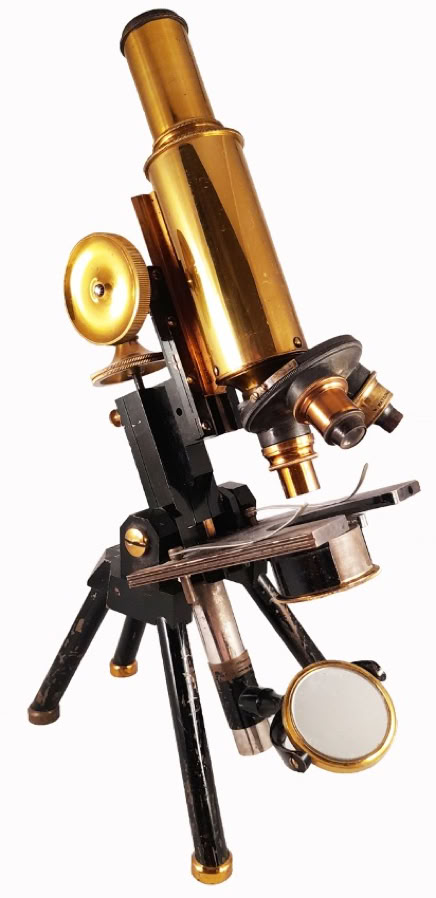


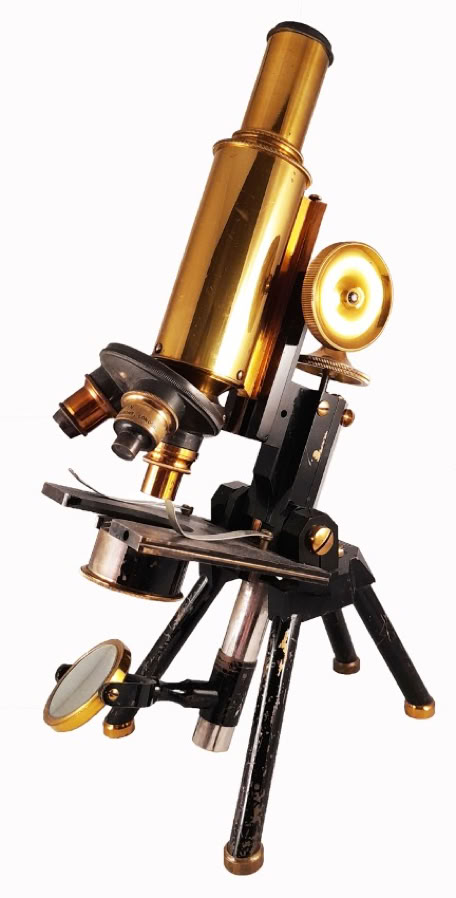
Microscope 158
(J Swift & Son; four-legged microscope stand; c. 1895)
James Swift was a London-based microscope maker whose business was founded in 1853 by James Powell Swift, the son of watchmaker Thomas Swift. Before establishing his own company, James Swift had served an apprenticeship with the renowned microscope maker Andrew Ross. In 1881, the firm introduced improvements to microscope design, including helical-cut components to replace the conventional straight rack-and-pinion focusing mechanism, together with a new fine-focus system. In 1884, Mansell James Swift, the founder’s son, joined the business, and the company name was changed to James Swift & Son. In 1901, the firm supplied microscopes to Captain Robert Falcon Scott for use aboard the R.R.S. Discovery during the 1901–1904 Antarctic expedition. These instruments were listed in the contemporary catalogue as the ‘Discovery’ model. In 1903, Mansell Powell John Swift, the founder’s grandson, joined the company. James Powell Swift died in 1906, and in 1912 the business was incorporated as a limited company under the name J. Swift Ltd. In 1942, both Mansell James Swift and Mansell Powell John Swift died. Four years later, E.R. Watts & Son Ltd acquired the company, partly reflecting the longstanding association between the Watts and Swift families. In 1949, the firm employed John H. Basset, who eventually took over the business in 1968.
Microscope 158 is signed ‘J. SWIFT & SON, LONDON N.W, PATENT 24960’ and can be dated to approximately 1895. The instrument was described in the company’s catalogues as the ‘Swift & Son’s recently patented 4-legged microscope stand’. Its distinctive feature is the pair of rear legs, which pivot to allow them to be reversed for packing. This arrangement reduced the space required for storage and transport, enabling the microscope to fit into a smaller case (Figure 1). Other instruments incorporating variations of Swift & Son’s four-legged stand were also offered, including a portable histological microscope and a petrological microscope.
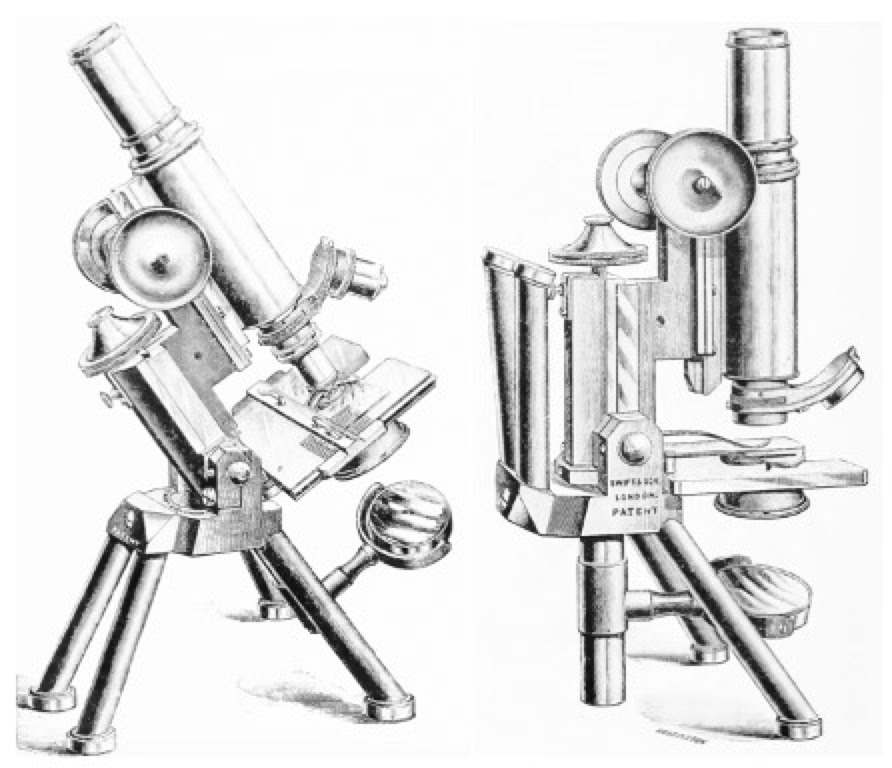
Figure 1. The Swift & Son’s 4-legged microscope as pictured in the 1894 volume of the Journal of Royal Microscopical Society.