
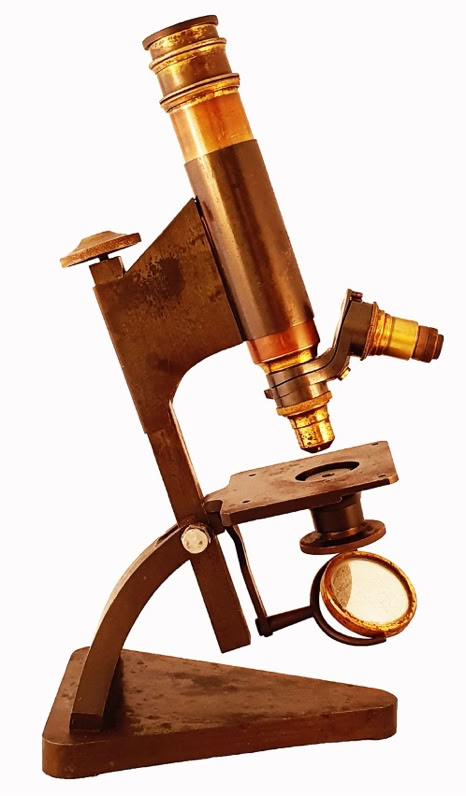

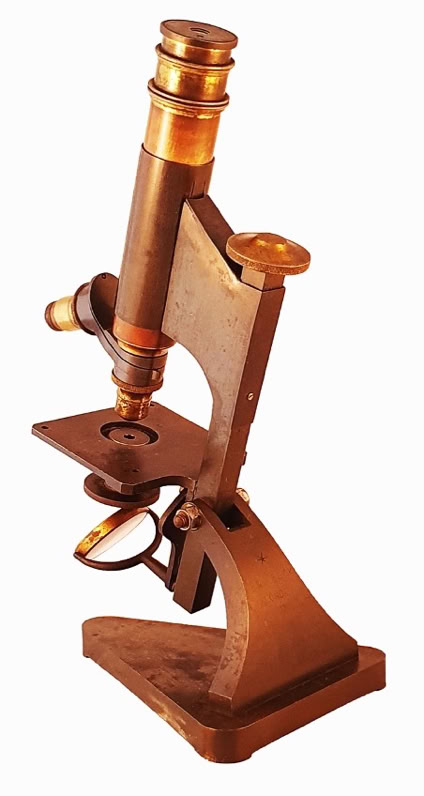
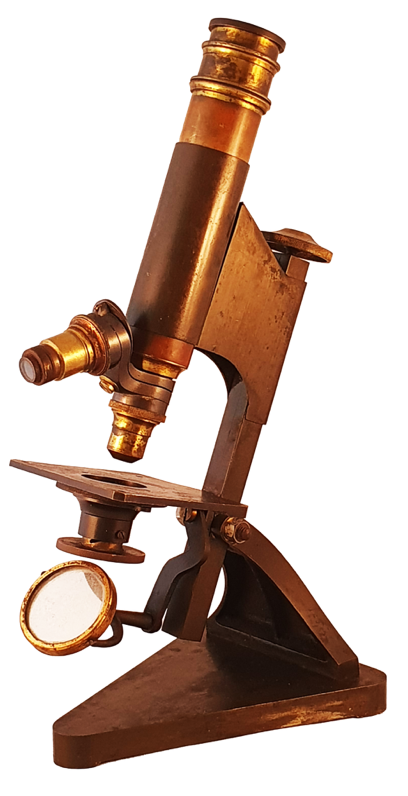
Microscope 114
(R & J Beck; new star microscope; c. 1900)
R & J Beck occupies an important place in the history of British microscope manufacturing. The firm's origins lie in the optical instrument-making business established in London by James Smith (1800–1873), who entered into partnership with Richard Beck (1827–1866) in 1847. Richard's brother, Joseph Beck, subsequently joined the business. Both brothers were nephews of Joseph Jackson Lister, the British optician and physicist renowned for his pioneering work on achromatic lenses and his contributions to the development of the compound microscope. In developing his improved microscope, Lister worked with James Smith, then an employee of the instrument-making firm of William Tulley, who constructed the microscope stand. Smith established his own optical instrument workshop in 1837. Through Lister's influence, his nephew Richard Beck began an apprenticeship with Smith in 1843. In 1847, Smith and Richard Beck entered into partnership, establishing Smith & Beck. The firm became Smith, Beck and Beck in 1854, following Joseph Beck's admission to the business in 1851. When Smith retired in 1865, the company adopted the name R & J Beck, which it retained for many decades. Richard Beck died prematurely in 1866, aged 39, and Joseph continued to run the business. In 1895, the company became a limited liability business under the name R & J Beck Ltd. By 1968, it had become a subsidiary of the American Ealing Corporation. A later successor to the Beck optical engineering tradition is Beck Optronic Solutions Ltd., which traces its heritage to the original firm.
Microscope 114 is a Beck New Star model, dating from around 1900 (Figure 1). It bears serial number 119396. The New Star succeeded an earlier model introduced in 1885, which featured a cast-iron base and a brass body with nickel plating. The later instrument combines black-finished metal components with lacquered brass. Coarse focusing is achieved by sliding the body tube, although versions fitted with rack-and-pinion focusing were also produced. A removable iris diaphragm screws into the underside of the stage. The plane-concave mirror is mounted on an articulated arm attached to the limb, allowing it to be swung over the stage to provide oblique illumination.
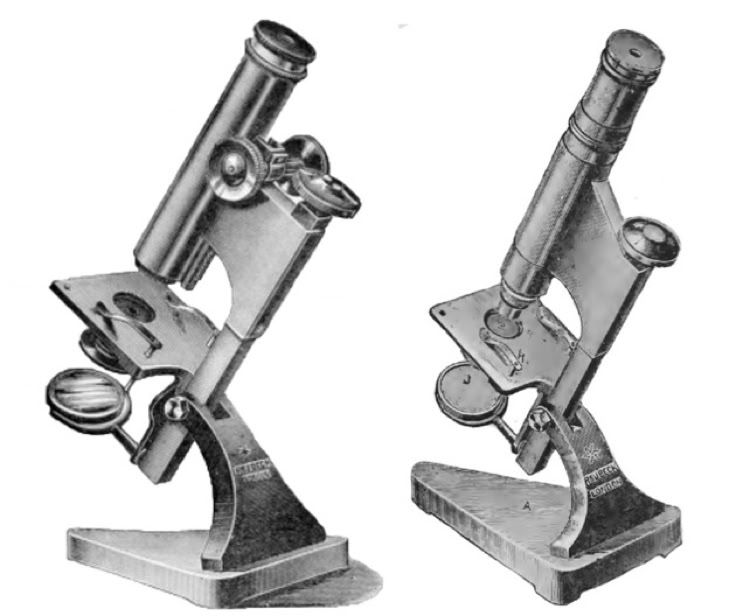
Figure 1. Beck’s New Star model microscopes with rack and pinion (left) and sliding tube (right) coarse focussing (adapted from the ‘Illustrated catalogue of microscopes, object glasses and apparatus manufactured by R. & J. Beck Limited’, 1894)