

Microscope 11
(R & J Beck; microscope model 47; late 1940s)
R & J Beck occupies an especially important place in the history of British microscope manufacturing. The firm's origins date to 1847, when Richard Beck (1827–1866) entered into partnership with James Smith (1800–1873) in London. Richard's brother, Joseph Beck, subsequently joined the business, which eventually became known as R & J Beck. Richard and Joseph Beck were nephews of Joseph Jackson Lister, a distinguished British optician and physicist whose pioneering work on achromatic lenses helped establish the foundations of modern optical microscopy. In developing his improved microscope, Lister worked with James Smith, who was then employed by the instrument-making firm of William Tulley, to produce the microscope stand. Smith established his own optical instrument workshop in 1837, and, through Lister's influence, Richard Beck began an apprenticeship with him in 1843. In 1847, Smith and Richard Beck entered into partnership, forming Smith & Beck. In 1854, following Joseph Beck's entry into the business in 1851, the company was renamed Smith, Beck and Beck. James Smith retired in 1865, and the firm adopted the name R & J Beck, under which it continued to operate for many decades. Following Richard Beck's premature death in 1866, aged just 39, Joseph Beck continued to run the business. In 1895, the company became a limited company under the name R & J Beck Ltd. By 1968, it had become a subsidiary of the American Ealing Corporation. Beck Optronic Solutions Ltd, established much later, is a successor to the former R & J Beck business.
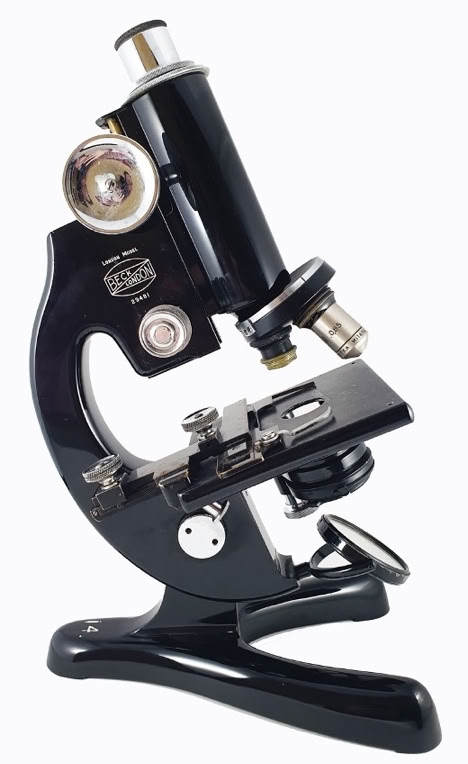
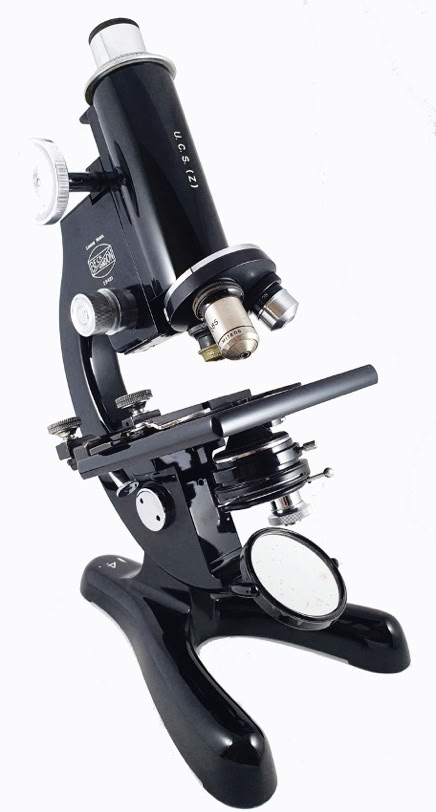
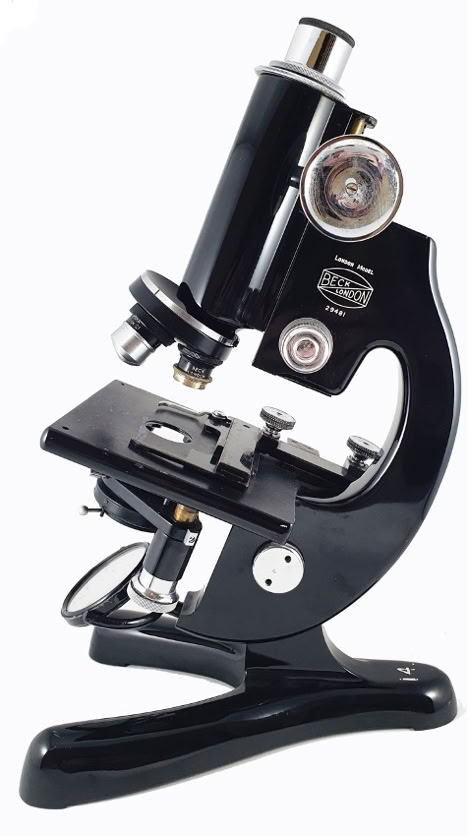
Microscope 11 is a Beck Model 47 (stand 47B) microscope, dating from the late 1940s (Figure 1). Its black-finished stand has a Y-shaped foot and a short pillar supporting the curved limb. The body tube is raised and lowered by rack-and-pinion coarse focusing, while fine focusing is controlled by a graduated knob on the limb. The eyepiece fits into a graduated draw tube that telescopes from the top of the main body tube, and a rotating nosepiece carrying the objectives is fitted at its lower end. Beneath the square stage, the substage condenser is mounted on rack-and-pinion adjustment and incorporates an iris diaphragm and a pivoting holder for aperture discs. Illumination is provided by a plane-concave mirror mounted in a horseshoe-shaped holder at the lower end of the limb. The microscope bears the serial number 29481.

Figure 1. Beck’s microscope, stand No. 47B, as featured in a 1951 catalogue of the firm.