


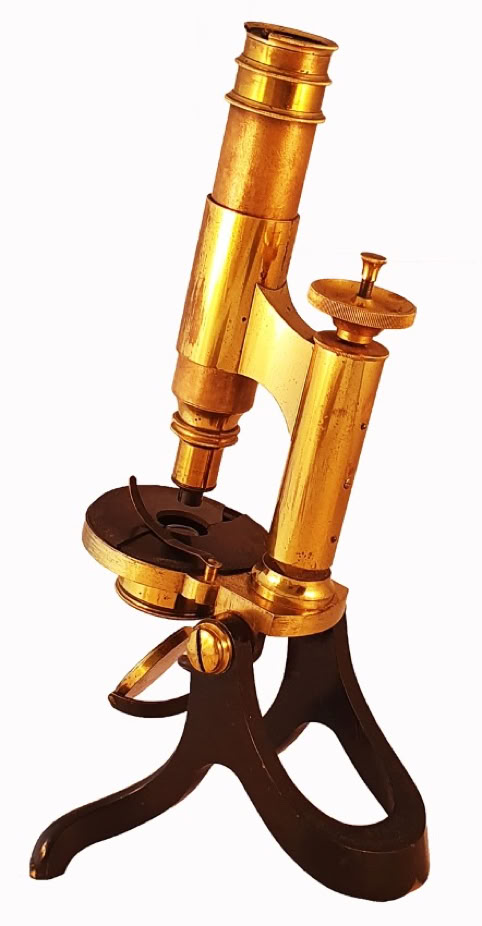

Microscope 107
(WF Stanley; late 19th Century)
William Ford Stanley (1829–1909) became a successful entrepreneur and prolific inventor, eventually establishing himself as one of the leading figures in Croydon, Surrey. In 1854, he began manufacturing and selling mathematical and drawing instruments from premises at 3 Great Turnstile, Holborn, London. Either before the business opened or shortly afterwards, he entered into partnership with his cousin, Henry Robinson, and the firm traded as Stanley and Robinson. A second retail outlet was soon established at 3 Holborn Bars. Within a decade, Stanley had expanded the product range to include microscopes. In 1875, Stanley opened the Stanley Works in South Norwood, Surrey. Designed by Stanley himself, this substantial factory was intended to facilitate the efficient manufacture of scientific, mathematical and engineering instruments. In 1900, the business was incorporated as W. F. Stanley and Company, Limited, with William retaining a majority shareholding. Around 1905, the company opened a new retail premises at 286 High Holborn, London. It continued manufacturing instruments for much of the twentieth century before being liquidated in 1999.
Microscope 107 bears the engraving ‘STANLEY, 13 Railway Approach, London Bridge’ and can be dated to the third quarter of the nineteenth century. The instrument is accompanied by its original wooden case.