
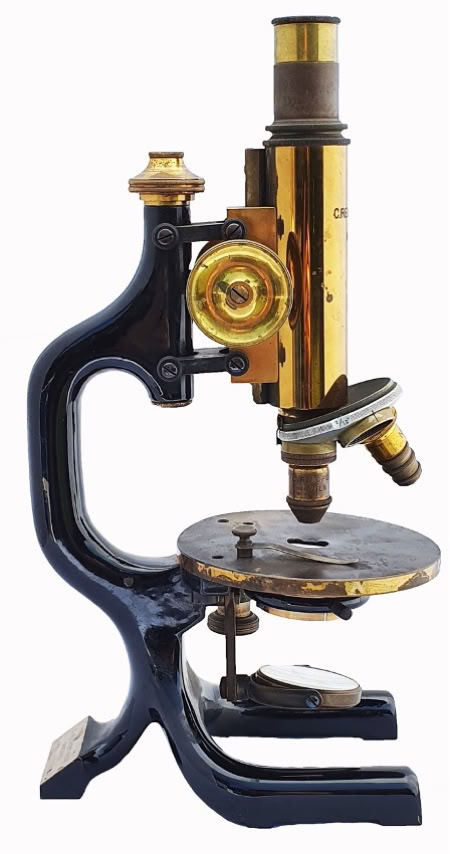


Microscope 102
(C Reichert; microscope model VII; 1910s)
Carl Reichert (1851–1922) was an Austrian optician who established one of Europe's leading microscope manufacturing firms in the late nineteenth century. In 1874, he married into the Leitz family, becoming the son-in-law of Ernst Leitz. Two years later, in Vienna, he founded Optische Werke C. Reichert. Reichert employed several technicians from the Leitz company in Wetzlar, which helps explain the similarities between the microscopes produced by the two firms. Reichert developed new optical systems, microscope illumination equipment and innovative instruments, including one of the earliest microscopes designed for examining metal surfaces. By 1900, the company had manufactured approximately 30,000 microscopes, a figure that had risen to 100,000 by 1930. Its instruments were generally signed C. Reichert, Wien. In 1962, Reichert was partially acquired by American Optical, which was itself taken over by Warner-Lambert in 1968. In 1986, Reichert was merged with Jung of Heidelberg and subsequently sold to Cambridge Instruments. The latter merged with Wild-Leitz in 1990 to form the Leica Group. In 1999, Reichert ceased manufacturing microscopes and concentrated instead on instruments for specimen preparation in transmission electron microscopy.
Microscope 102 bears the signature C. Reichert, Wien and the serial number 45063. It can be dated to approximately 1910 and identified as Model VII in a Reichert catalogue from the 1910s (Figure 1). The instrument is preserved with its original wooden case, although the condenser is missing.
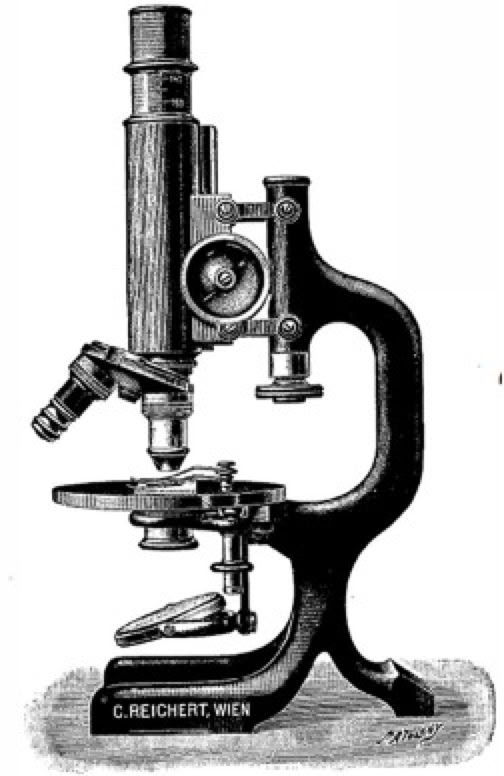
Figure 1. Reichert’s model VII microscope as engraved in a firm’s catalogue from the 1910s.