
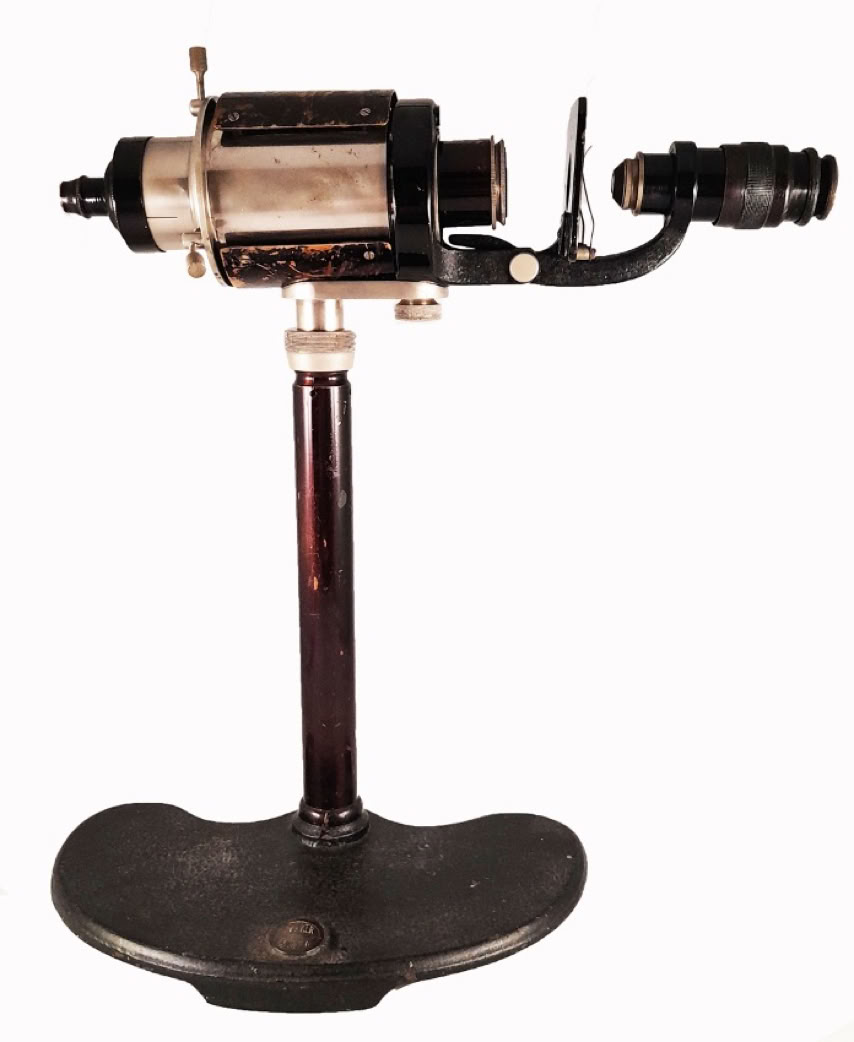
Object 16
Microslide projector by Charles Baker (late 1930s)
A Charles Baker School Micro-Projector Apparatus, Model A, dating from the late 1930s (Figure 1). Designed primarily for educational use, the instrument was intended to project enlarged images of microscopical specimens for classroom demonstrations. The apparatus consists of a small horizontal compound microscope, based on Baker's Improved Nature Microscope, combined with a projection lamp and mounted on a distinctive kidney-shaped cast-iron base. The instrument could be supplied with or without an AC or DC transformer for powering the lamp. Magnification is adjusted by sliding the drawtube, which is engraved with numbers indicating the corresponding magnifying powers. The instrument bears the inscription "Baker, London" and the serial number 11582.
The origins of the Baker business date back to around 1765, although it was Charles Baker (born 1820) who gave his name to the company from approximately 1851. Following his death in 1894, the firm continued trading under the same name, managed by the Curties family. In 1936, it became Charles Baker & Co., subsequently adopting the name C. Baker Ltd. sometime during the 1940s. The firm's premises were located principally at 244 High Holborn, London, although contemporary records also give the addresses 243 and 245 High Holborn, sometimes in combination. Baker manufactured a wide range of optical and surgical instruments, including microscopes and their accessories. In 1963, Vickers acquired the microscope manufacturing factory of C. Baker Ltd, leading to the formation of a new company, Vickers Instruments.

Figure 1. Baker’s school micro-projector apparatus, model A, as illustrated in the 11th edition of the Gallenkamp general catalogue (1939).