

Object 14
Cobweb eyepiece micrometer by R & J Beck (1930s)
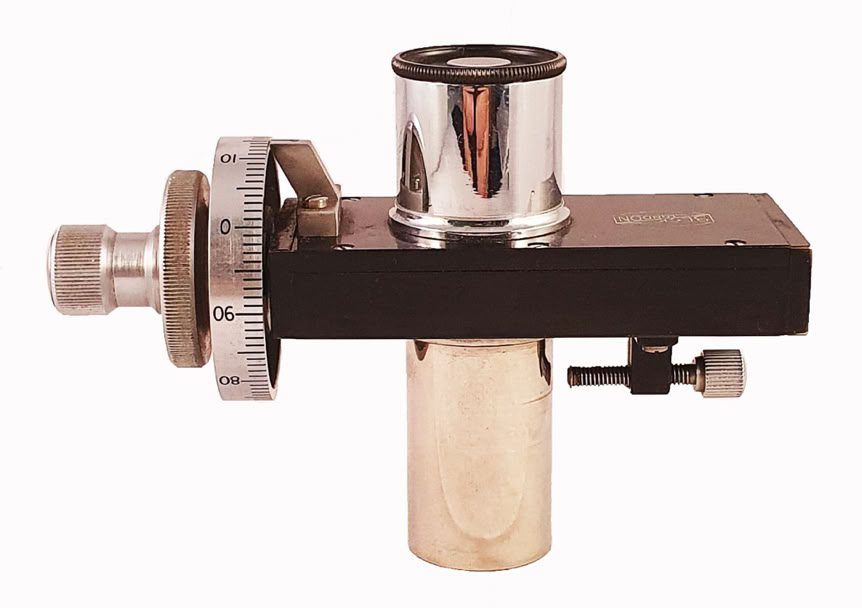
A cobweb eyepiece micrometer manufactured by R & J Beck of London and dating from the 1930s (Figure 1). The eyepiece contains two fine cobweb threads, one fixed and the other movable by means of a micrometer screw. The screw has a pitch of 1 mm and is fitted with a graduated drum divided into 100 divisions, each corresponding to a movement of 0.01 mm. A saw-toothed scale is also provided, with the spacing between successive teeth corresponding to one complete revolution of the micrometer screw.
R & J Beck occupies an important place in the history of British microscope manufacturing. The company's origins date back to 1847, when Richard Beck (1827–1866) entered into partnership with James Smith (1800–1873), who had established his own optical instrument workshop in London in 1837. Richard Beck was the nephew of Joseph Jackson Lister, the distinguished British optician and physicist whose pioneering work on achromatic lenses contributed significantly to the development of the modern compound microscope. Through Lister's connections, Richard Beck was apprenticed to Smith in 1843, having previously been introduced to the instrument-making trade through his uncle's work with the firm. In 1847, Smith and Beck established a partnership under the name Smith & Beck. The business was renamed Smith, Beck & Beck in 1854, following the admission of Richard's brother, Joseph Beck (1828–1891), who had joined the firm in 1851. Following James Smith's retirement in 1865, the company adopted the name R & J Beck, under which it became particularly well known. Richard Beck died prematurely in 1866, aged just 39, and Joseph continued to manage the business. In 1895, the company became a limited liability company, trading as R & J Beck Ltd. By 1968, it had become a subsidiary of the American Ealing Corporation. The Beck name survives today through Beck Optronic Solutions Ltd, a successor to the former R & J Beck business.
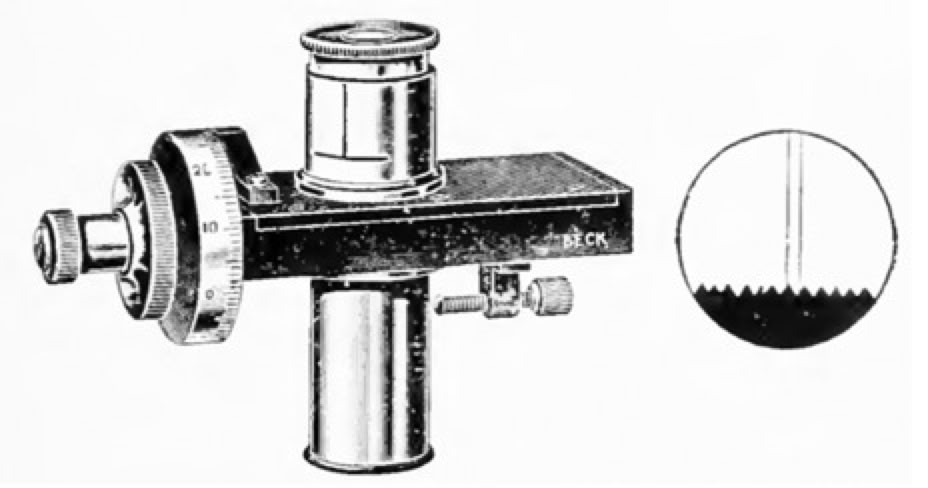
Figure 1. Beck’s cobweb eyepiece micrometer as pictured in a company’s catalogue from the 1920s – 1930s.